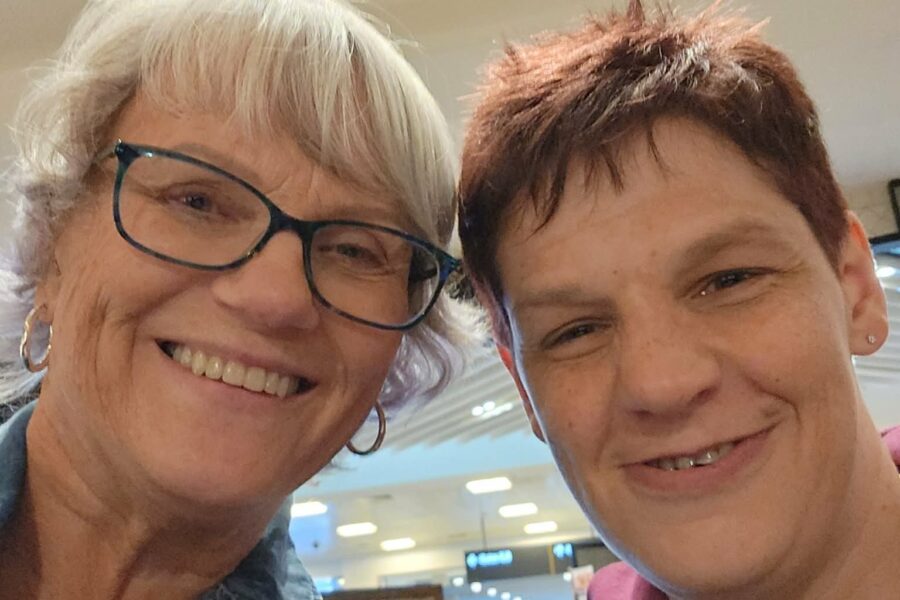
Stevie Wills
POETRY: ‘See The Moments‘
What moments of vibrancy are around you
waiting for you to witness?
Signs of vitality
for you to see?
Signs dismissed
Overlooked by others?
The invitation?
To be as my Mum.
She who was told to not expect anything from me
took daily trek to Royal Women’s Hospital.
The first four weeks of my life, she spent hours…days by my side.
She watched me.
She noticed
following of eyes. Movement of hand.
Signs of life…vitality…vibrancy.
No expectations, doctors advised.
I live with cerebral palsy. I have grown into a performance poet, public speaker and writer. I have advocated for the inclusion and empowerment of people with disabilities for over a decade. I run my own business.
The invitation?
to be as my Mum.
To watch
and watch.
To notice.
To see the signs
of life
vitality
vibrancy.
I called my business Inclusion Vibrancy. Every person has unique skills, talents, personalities and perspectives. Every person has unique contributions to make to their community. Inclusive communities are vibrant communities because they enjoy everyone’s unique skills, gifts, talents and perspectives.
People with disabilities often face barriers to fully participating in their community. When people with disabilities find themselves on the margins, their whole community is missing out; lacking their unique contributions.
When I was at secondary school I wasn’t bullied, but I struggled to keep up with my peers. I was left out…left behind. My peers moved around the schoolyard at a fast pace. Even using my electric wheelchair at highest speed, I couldn’t keep up with them. The school split into three elongated levels. In the middle, one ramp joined the two higher levels, while another ramp joined the two lower levels. I would often spend an entire lunchtime trailing behind my peers. They would often go up the stairs, and I would have to go the long way round. By the time I neared the top of the stairs, I had lost sight of them. It takes me longer to get my words out, so in group conversations I could never get a word in.
Throughout secondary school, because I was left behind, friendships with my peers never had a chance to develop. It was painful…lonely.
Now I run workshops to equip communities for inclusion and accessibility. My workshops and presentations support communities on a journey to identify and remove barriers that prevent people with disabilities from fully participating. This leads to Inclusion Vibrancy; communities enjoying fullness of diversity in skills, gifts, personalities and perspectives.
My workshops for young people equip them to ensure that their peers with disabilities are no longer left behind. I combine my lived experience, humour, theory, and practical steps that teenagers can take towards building inclusion into their communities.
I would love to bring Inclusion Vibrancy to your community! Your school, community or youth group.
You can find out more at steviewills.com.au or contact me at contact@steviewills.com.au
Stevie’s 5 Tips to begin Including People with Disability
1. Inclusion starts with relationship
Genuine friendship. Reciprocal relationship. It is not driven by pity or duty. Inclusion starts with spending time with people…recognising the value and contribution of people with disabilities.
2. People with disabilities are interested in the same topics of conversation as those without disabilities.
My disability is not front of mind – it often fades into the background. I’m an aunty, sister, daughter, artist, and advocate for people with disabilities. I’m a lover of music. I’m passionate about justice and seeing all people flourish. This is who I am. From these do my thoughts flow. I live with a disability, but I’m not disabled. It’s not who I am. It’s an aspect of my life… but we have lots of commonalities to talk about!
3. Recognise that society creates barriers
The way society is built, and how it operates, marginalises people with disabilities. 1 in 5 Australians live with a disability, rendering it a common experience among humanity. Yet inaccessibility remains. Building inclusion and accessibility into your community requires the barriers that exist to be identified and removed.
4. Learn from people with disabilities’ perspectives
We have firsthand knowledge of barriers and extensive experience in problem-solving and navigating obstacles. During a conversation with a person with a disability, perhaps you could ask them about the barriers that they face. Where they experience marginalisation? If there’s anything that they can’t fully participate in and how you can work together to remove those barriers.
5. Discover preferred ways to communicate
It might be sitting rather than standing. It might be sitting in a quiet place or ensuring the person can clearly read visual clues on your face. It might be walking slower as you talk… going up the ramp together, rather than walking ahead. It might be texting rather than phone calls or vice versa.