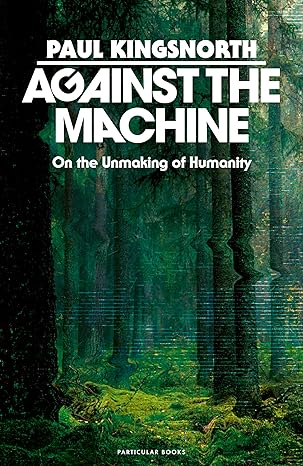
Paul Kingsnorth, Against the Machine. On the Unmaking of Humanity. London: Particular Books, 2025, 384 pages, hardback.
Reviewed by Paul Tyson
Kingsnorth’s book genre sits broadly within Jacques Ellul’s analysis and critique of the technological society. You might call it a philosophy of technology book, theologically framed and sociologically expressed. Like Ellul, Kingsnorth ranges across sociology, theology, Scripture, philosophy, and technology studies. His book has a glowing back cover endorsement by Iain McGilchrist and opens with a Wendell Berry quote. This book makes for a fascinating and far reaching read, but it defies siloed genres and does not sit within any one clean theoretical or directional thesis. It has about it the aroma of the variegated complexity of our actual experience of life.
Broadly speaking, Kingsnorth is wrestling with what he sees as the profoundly spiritual dynamic of the technological powers of humanity. It is not that such powers are intrinsically wrong or can be in any manner avoided or denied—we are tool-making and world-altering animals—but our technological powers are fallen, and this has at least three unavoidable implications to Kingsnorth. Firstly, any sort of blanket techno-optimism is called out as an idolatrous and false eschatology, and by no means spiritually neutral or benign. Secondly, idolatrous techno-optimism is situated within the context of spiritual warfare. We are being drawn to our doom by the false promises of our own god-like technological powers by darker and higher powers than ‘the natural man’ can see. Thirdly, the beauty of creation, and its highest meaning as a pathway to the Creator, are understood within the long tradition of Christian hermits. Protecting nature and our own souls from the spiritually crushing energies of ‘The Machine’ is a Christian responsibility.
Reading Kingsnorth reminded me of reading the English historian, Herbert Butterfield (1900–1979). Butterfield was, as far as I can tell, the last humdrum academic historian writing in English to understand the value of the Western Christian analytical tool called sin. Sin explains human behaviour better than anything else. For if we inherently tend towards ‘missing the mark’ of our image of God bearing human dignity, this accounts for both the glory and the depravity of human history and means that we are not gods nor mere brutes. It also allows for responsibility, repentance, and grace-enabled redemption in human affairs. That is, both Butterfield and Kingsnorth think about public and ‘secular’ (in the proper meaning of the word, i.e. ‘of the age’) matters with an unapologetically theological lens. Thinking about technology theologically is of particular importance, it seems to me, when it comes to trying to understand Artificial Intelligence.
Kingsnorth’s book ranges far and wide in trying to explain to us what he means by the dark encroachment of ‘The Machine’ on human affairs. But for the rest of this review I will zoom in on what he says about Artificial Intelligence.
Drawing on the French Sufi mystic, René Guénon, Kingsnorth finds that Western culture has been seduced into a lifeworld governed by the “Reign of Quantity”—which Zoroastrians called the demonic principle of Ahriman. In his 1945 book, The Reign of Quantity and the Signs of the Times, Guénon discerned that the West had entered an era defined by the broad cultural assumption that only the quantifiable, only what can be measured and sensed, is real. This is a culture-wide spiritual bondage. Religion can be carved out of the public and scientific domain of objective truth, ‘preserving’ the private ‘freedom’ of supernatural belief and divine-command morality, but that sits within the principality of Ahriman.
This little review is no place to get into the demanding question of whether there is a valid distinction between ‘methodological naturalism’ (treating the natural world as if only empirically verifiable, non-supernatural causes are real) and ‘metaphysical naturalism’ (the belief that only material things and forces are real), but the mystic’s point is that at a public lifeworld level that distinction has become meaningless. We functionally live together as if only the quantifiable is real and this powerful ruling principality governing the norms and assumptions of our collective way of life.
A note here: Kingsnorth draws on the Sufi Guénon and the Anthroposophist Rudolf Steiner to unpack an analysis of our times as being defined by the spiritual principle of the reign of quantity. This somewhat reflects Kingsnorth’s own journey from Dark Green (i.e., neopagan) activism, eventually coming out of both paganism and the Green movement and finding home with Christ in the Romanian Orthodox church. Kingsnorth has come on a long journey to faith, which was a radical and non-conformist search for harmony with both creation and the Creator. But for Kingsnorth, the nature of our collective suffering means that the way forward has to be radical and has to be at odds with our exploitative subjugating approach to nature, as governed by Western technocratic, political, and financial power. As the West’s dominion approach to nature has deep ties in Francis Bacon’s theology of Adam, it is no surprise that Kingsnorth is interested in observers who are not committed to our modern Western ‘Christian’ roots.
There is much value in Kingsnorth’s approach, which is very aware of how cultural Christianity, whether secularized or religious, is almost by definition subject to corruption as a vehicle for power. Kingsnorth has no sorrow over the demise of Western cultural Christianity and is very attuned to how ‘Christian’ attitudes can be at one with ‘The Machine.’ So, Kingsnorth’s reading of the unholy linkages between modern Western Christianity and opposition to a creation affirming and neighbour respecting ethic is not for the theologically faint-hearted.
When it comes to AI, Kingsnorth notes that a purely quantitative, materialist, and technological approach is running totally blind to the spiritual implications of what it is doing. Typically, modern philosophers of mind assume that thinking brains are emergent properties of matter that spontaneously arise from high levels of neurological complexity. If anyone wants to really look into this, they should read David Bentley Hart’s All Things are Full of Gods, which philosophically destroys mind-out-of-matter emergence (matter-out-of-mind is the traditional and persuasive stance), and Iain McGilchrist’s The Matter with Things, which is a neurological explosion of any simplistic mechanistic understanding of the thinking mind. But when it comes to our computational technology, in our situation we cannot see how large language models mimicking human reasoning actually work. Complexity indeed has become a shroud to us in understanding AI. Mimicking the brain’s neural complexity via super-large databases and super-fast ‘quantum’ processing, we have effectively created a replication of human reasoning black box. Along with Oxford mathematician John Lennox (see his 2084: Artificial Intelligence and the Future of Humanity), Kingsnorth sees this as producing the very serious potential for demonic spiritual intelligences to reach into the human world in invasive ways. Kingsnorth notes:
Transhumanist Martine Rothblatt’s new religion, Terasem, says that by building AI systems ‘we are making God.’ Fellow transhumanist Elise Bohan says, ‘We are building God.’ Kevin Kelly believes that ‘we can see more of God in a cell phone than in a tree frog.’ ‘Does God exist?’ asks Google maven Ray Kurzweil; ‘I would say, “not yet.”’ (p. 256)
These Big Tech gurus are not fringe figures: they are powerful technologically and commercially enabled culture influencers.
Creating ‘God’ in our own image and then bowing down and worshiping the works of our own hands, and finding that our idols have a profound spiritual power over us (and others), is as old as the hills. What is new is that modern technological and functionally materialist Man is engaged in this ancient idolatry without any appreciation of the anti-human dark spiritual energy he is conjuring into the world. (Lennox thinks this is what Revelation’s Beast is, and we could be making it right now.)
Kingsnorth makes these concluding comments in one of his AI chapters:
Prelest [that is, spiritual delusion or deception] is often a result of spiritual pride. It might manifest, for example, among people who imagine that they are powerful enough to ‘build God’. They might imagine they are ‘ushering in’ something divine when they are, in fact, ushering in the precise opposite. Whatever is quite happening, it feels to me as if something is indeed being ‘ushered in’… The world is being prepared. Something is coming. Be ready. (pp. 260–261)
C.S. Lewis makes the same point in That Hideous Strength. Knocking on the door of spiritual power, even in the modern and materialist name of technological realism, one must beware as something might just answer one’s knock from the other side.
This is a disturbing and highly profitable book if one is interested in how Christian theology and practice must be at odds with the spirit of technological dominion which so easily takes on idolatrous and hubristic demonic energy in our times. This is a timely and important book.
This review appears in Zadok Perspectives 171: AI and Digital Discernment. It is reproduced here with a correction.