Mike Bird and Joey Dodson
Hi everyone, I saw Christopher Nolan’s The Odyssey, and I loved it. It was a great story, with great action, and a moving account of a man’s love for his wife, son, and homeland. Oh, and lots of monsters!
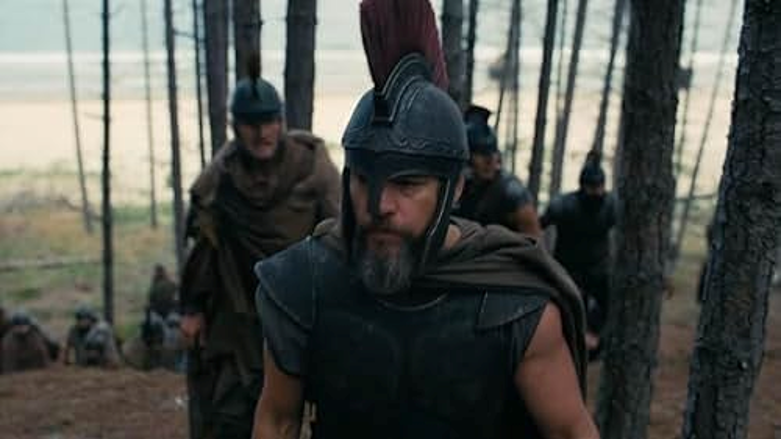
I have to confess that I can’t stomach the political whinging around the film that it was too woke because it had a black Helen of Troy, or else it was too pro-Western civilization since it lionizes the Western canon of which Homer’s works are the starting point.
That said, there is a tacit “Christianization” in the film as Odysseus does find himself pondering – after sacking Troy through subterfuge and without mercy – whether “We were the baddies after all” so to speak. Yet that is not something that ever entered Alexander the Great’s mind; it is, though, a symptom of the introspective moral conscience of a Christianized society.
In any case, I’ve got my brother and buddy Dr. Joey Dodson writing his reflection on the movie as someone who is an expert in Greek epics, religion, and philosophy. Enjoy!
The deadline for my decision had arrived. I paced my office in inner-city Houston, praying for a sign. If I stepped out to relocate my wife and three young kids to Scotland, would the Lord really provide? Although I had once been certain he was calling me to pursue my PhD at the University of Aberdeen, the current lack of financial support caused significant doubt. So, as best as a Baptist could do, I asked the Lord to speak to me. But I heard and felt nothing except the sound of my heart racing and the amount of my anxiety rising. I can’t remember how long it was after my petition that I heard the knock on the door. I figured it was one of the many unhoused people who called on our church’s food pantry. When I opened the door, I could tell from the looks of him I had guessed correctly. Distracted with discerning God’s will for my life, I just waved him inside and led him to the bags of rice and cans of beans. After I loaded him down with non-perishables, he spoke up to thank me. When I heard his accent, my jaw dropped. Although I had served countless unhoused people here, I had never heard one of them sound like this. Wide-eyed, I blurted: “Sir, where are you from?” As if he got that a lot, he smiled a toothy grin and boasted with a thick brogue: “I’m from Scotland, brother.” Christopher Nolan’s recent film caused that memory to come flooding back to my mind. As far as I can tell, Nolan coins the phrase “Zeus’ Law,” which picks up on a major theme in Homer’s version regarding the utmost importance of showing hospitality (ξενία or φιλοξενία) to beggars, visitors, and strangers.[1] To be sure, there are numerous parallels with the Odyssey and the New Testament, whether it be Paul’s nautical journey and shipwreck in Acts; the disciples’ knack of not getting it in Mark; or Jesus’s encounter with Legion in comparison to the hero’s standoff with Polyphemus.[2] But what coheres most between the Odyssey and the Bible regards hospitality. In the Greco-Roman world, Zeus was known to disguise himself to separate the godly from the ungodly by how they treated strangers.[3] Related to this, they believed that since Zeus cared for the poor, he wanted people to do so, too. For this reason, one of his titles was Ζεὺς Ξένιος (Zeus Xenios),[4] namely, “Zeus-the-Friend-of-Strangers.”[5] This divine characteristic accords with the common conviction that Eumaeus, Odysseus’s pig farmer, declares: “all strangers (ξεῖνοί) and beggars (πτωχοί)[6] are from Zeus.”[7] This belief was so ubiquitous that even Penelope’s wicked suitors know it. For instance, when Antinous tosses the stool at Odysseus disguised as a beggar, they promptly call their compatriot out and warn that he will be doomed if that poor man turns out to be an undercover god, known to assume humble forms to expose human lawlessness.[8] The proper term for this phenomenon is theoxenia, and it explains why the pagans in Lystra were so quick to conclude that Paul and Barnabas were Hermes and Zeus in Acts 14. When the crowds saw what Paul had done, they shouted, saying in the Lycaonian language, “The gods have come down to us in human form!” 12 Barnabas they called Zeus, and Paul, Hermes, because he was the chief speaker (14:11-12; CSB). The author of Hebrews expresses a similar notion: Don’t neglect to show hospitality (φιλοξενίας),[9] for by doing this some have welcomed angels as guests (ξενίσαντες) without knowing it (Heb 13:2; CSB).[10] Of course, rather than hosting an angel in disguise, the two disciples on the road to Emmaus unknowingly entertain the resurrected Jesus Christ. Now that same day two of them were on their way to a village called Emmaus, which was about seven miles from Jerusalem. 14 Together they were discussing everything that had taken place. 15 And while they were discussing and arguing, Jesus himself came near and began to walk along with them. 16 But they were prevented from recognizing him (Luke 24:13-16; italics mine). Eventually, the Lord does reveal himself to the two men, but only after testing them to see if they’d offer him hospitality. They came near the village where they were going, and he gave the impression that he was going farther. 29 But they urged him, “Stay with us, because it’s almost evening, and now the day is almost over.” So he went in to stay with them. 30 It was as he reclined at the table with them that he took the bread, blessed and broke it, and gave it to them. 31 Then their eyes were opened, and they recognized him, but he disappeared from their sight (Luke 24:28-31; italics mine). This parallels how the two herdsmen (Eumaeus and Philoetius) do not recognize Odysseus at first. But after the men show the hero hospitality, he reveals himself to them by showing them his scar.[11] Both the two disciples and the two herdsmen passed the hospitality test and therefore were considered worthy of seeing their respective masters. Speaking of herdsmen, Jesus promises in Matthew 25 to separate the sheep from the goats, the righteous from the unrighteous, based on how they showed hospitality to him. To those cursed and sent into the eternal fire, Jesus will say: “For I was hungry and you gave me nothing to eat; I was thirsty and you gave me nothing to drink; I was a stranger (ξένος) and you didn’t take me in . . .” (Mt 25:42–45). Christ continues to explain how the people will then cry out: “Wait, Lord, when did we see you hungry, or thirsty, or a stranger (ξένον) . . .?” According to Jesus, he will answer them: “Truly I tell you, whatever you did not do for one of the least of these, you did not do for me” (Mt 25:42–45). It turns out Zeus and Christ use a similar standard to distinguish between the godly and the wicked. Along these lines, Odysseus asks a recurring question: “Are these people violent, savage, and unjust or are they hospitable to strangers, with a god-fearing mind?”[12] This understanding also serves as the basis for his warning to the Cyclops regarding how “Zeus ξείνιος” is the avenger of suppliants and strangers.[13] Whereas Odysseus exacts revenge on the ungodly suitors, who discover the beggar’s identity too late to save their lives, Jesus condemns “goats” into eternal fire because of their mistreatment of him in their neglect of the poor. The Odyssey’s emphasis on hospitality makes the gospel even more striking. Just as Odysseus came back to his kingdom in the form of a beggar and was mistreated by the suitors, Jesus took on flesh and “came to his own, and his own people did not receive him” (John 1:11). This accords with what Matt Damon’s Odysseus tells Tom Holland’s Telemachus, “The clearest view for a man is from below.” When Christ made himself nothing and took on the nature of a slave, humanity did not toss a stool at him, they hung him on a cross. What’s worse, according to Revelation, even his own church in Laodicea neglected to show him hospitality despite his pleas to them. Reduced to the likes of a stranger, he cried to the wealthy believers there: “See! I stand at the door and knock. If anyone hears my voice and opens the door, I will come in to him and eat with him, and he with me” (Rev 3:20). The reader cannot escape the irony as “the ruler of creation” must beg for his people to let him in. Even though it verges on being redundant in the film, I love how Nolan shows the widespread conviction in the ancient world regarding how hospitality to poor strangers served as the litmus test for righteousness. In comparison, I grew up in a tradition that stressed the forensic aspect of righteousness. From that vantage point, my salvation centered on me asking God to forgive my guilt and justify me by imputing the righteousness of Jesus to me. While I still believe that is a faithful aspect of the gospel, for the last twenty years, I have focused more on an apocalyptic emphasis of righteousness, which highlights it as God’s work of deliverance through Christ to victoriously rescue and redeem humanity from slavery and bondage to demonic powers. But what I had failed to underscore for years – until I read the work of Josh Jipp – is what we see in the Odyssey as well as in Scripture: righteousness as an act of divine hospitality.[14] That is, I was not only a culprit in need of reconciliation and a captive in need of liberation: I was a beggar who needed acceptance. And Jesus, “the-Friend-of-Strangers” (ΧριστὸςΞένιος!), graciously invited me in. What’s more, he bestowed his riches upon me (Rom 10:12-13) and made me his kin (Rom 8:16-17). And, because of the Lord showing hospitality to us, he expects us to show hospitality to others. This is righteousness as hospitable reciprocity! “Therefore welcome one another, just as Christ also welcomed you, to the glory of God” (Rom 15:7). Thirty years ago, I almost missed that Scot at the door because I was in the weeds of trying to “find God’s will for my life.” It turned out that first and foremost his will is for me to open the door to strangers, because their knocks on the door are his. And welcoming a stranger as a brother is a way of welcoming Him. This is the way of Christ. Joey Dodson is associate professor of New Testament at Denver Seminary, co-author of Paul and the Giants of Philosophy: Reading the Apostle in Greco-Roman Context, the author of Paul the Rabbi Philosopher: Stoic and Jewish Philosophy in the Apostle’s Thought and the forthcoming Jesus, Hercules, and the Gospel Truth: Encountering Christ Among the Myths. [1] Whereas Nolan’s film explains that the “Zeus’ Law” is to treat others the way you want to be treated, especially those who are poor and powerless, Paul specifically states that the “Law of Christ” regards humbly bearing each other’s burdens (Gal 6:2-3). Although the apostle does not use that phrase in Romans, it seems reasonable that he would include loving your neighbor as yourself under that law (Rom 13:8-10). [2] For more on these, see Dennis R. MacDonald, The Homeric Epics and the Gospel of Mark (New Haven: Yale University Press, 2000); and idem., Does the New Testament Imitate Homer? (New Haven: Yale University Press, 2003). [3] To be clear, Zeus does not do this in the Odyssey, but Athena does. [4] Latin, Iuppiter Hospitalis. [5] This title even occurs in 2 Macc 6:2. [6] This is the word for “poor” in Jesus’s beatitudes: Blessed are the poor (Μακάριοι οἱ πτωχοὶ). See Luke 6:20. [7] Homer, Od. 14.56–58. [8] Homer, Od. 17.481–87. [9] For Paul’s use of this word, see Rom 12:13. Share with the saints in their needs; pursue hospitality (φιλοξενίαν). [10] For more on this, see Joseph R. Dodson, “Ethical Exhortations in the Letter to the Hebrews and the Writings of Seneca” in Son, Sacrifice and Great Shepherd. Studies on the Epistle to the Hebrews; edited by David M. Moffitt and Eric F. Mason; WUNT II (Tübingen: Mohr Siebeck, 2020), 233–252. [11] Compare John 20:27. [12] Homer, Od. 6.119–121. [13] Homer, Od.9.269–271. [14] Joshua W. Jipp, Saved by Faith and Hospitality (Eerdmans, 2017). See also his monograph,Divine Visitations and Hospitality to Strangers in Luke-Acts: An Interpretation of the Malta Episode in Acts 28:1-10 (NovTSup; Leiden: Brill, 2013). |