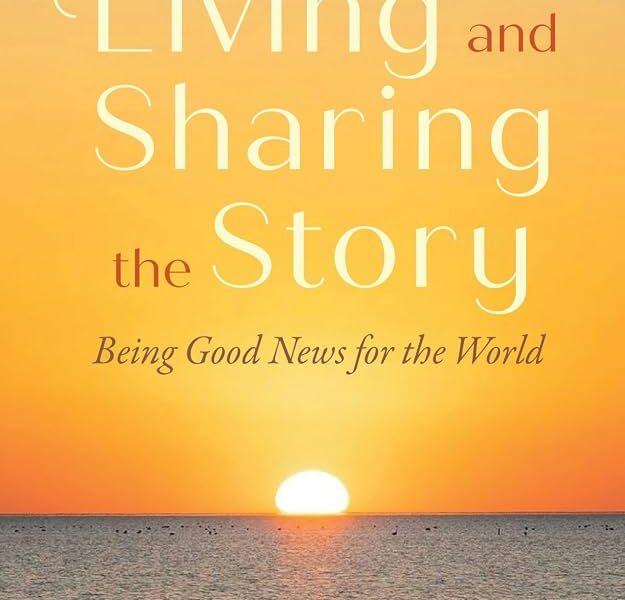
Charles Ringma, Living and Sharing the Story: Being Good News for the World, Mission Series One (Wipf and Stock, 2026), 54pp.
Reviewed by Neville Carr
I’ve journeyed with Charles Ringma for quite some time, at least from when both of us were teaching in the Philippines. Nowadays, that happens when we visit him and his lovely wife, Rita, in Queensland. It has been a privilege to share ideas about ministry, theology, church and mission over many coffees and meals. His most recent major work—In the Midst of Much Doing: Cultivating a Missional Spirituality (Langham Global, 2023)—will no doubt be a reference point for theologians, missiologists, church leaders and believers generally over the years ahead.
Here, in Living and Sharing the Story, the first of a four-book Mission Series, Charles invites readers, especially those new to the faith (and this accounts for a deal of content which more mature believers might take for granted) or with lots of questions, to ‘see the face of God’ (‘upward’) and neighbour (‘outward’), but also to gain ‘greater clarity’ about their own transformation in Christ through the Spirit (‘inward’) (p. xi). The aim is ‘invitational rather than prescriptive’ (xvi): concerning God’s salvation and purposes in history, along with the small part that we can play with others in that story to ‘trace the big picture of God’s salvation’ (p. xvii).
Several themes are covered: adapting to the church’s increasing marginal status, the decline in Scripture reading among Christians, a distorted view of God as a kind of Father Christmas, and the call to live as a ‘sign and servant of God’s presence, purposes, and reign in the world’ (xviii).
The book contains eleven short chapters that assert that Scripture grounds us in engaging with a confused and conflicted world and that Scripture alone can transform us as we open ourselves to its leading, standing under it, not over it (p. 2). We read not just for information, but to strengthen our relationship with God and understand ourselves better. As a literary, historical and theological book, we need certain skills to interpret it properly asking, for example, ‘What did it mean in its day and what does it mean now?’ Two ways of approaching scripture are mentioned – a scholarly or reflective approach (p. 5) – with a caution against picking out favourite portions, rather than the whole of scripture.
In the West, where Western individualism rules, Ringma reminds us that our faith is communal; hence, he advocates ‘a spirituality of community building’ (p. 19).
A missional spirituality incorporates ‘attentiveness, prayerfulness, and the challenging art of obedience, along with a genuine concern for the needs of others’ – demanding a balance between contemplation and action, self-care and service, sabbath and the work of justice, affirmation and critique (pp. 33-35).
Several questions arise for me. First, while affirming Chapter 5 on the Holy Spirit, I note the mistaken but all-too-familiar reference to ‘spiritual gifts’ (p. 24), a term which has no support in the original Greek. Pneumatika literally translates as ‘spirituals’, suggesting ‘spiritual things’ or ‘spiritual people’. The inference of ‘gifts’ is possibly drawn from the context. 1 Corinthians 12:1 in the most literal Revised Version of 1945 and NASB has ‘gifts’ in italics, a pattern used for a particular word not in the original. The NRSV and Christian Standard Bible footnotes have either ‘things’ or ‘persons’. Otherwise, ‘Now, concerning spirituals…’. My own sense is that there is a deliberate ambiguity with these two equally valid possibilities.
Second, I would have liked the reference to the ‘cultural mandate’ (p. 38) to have included ‘naming’ (Gen. 2:19f), with the inference of education, communication and the sciences, thereby linking up with an earlier reference to ‘critique’ or evaluation, a function sorely missing from many church structures and programmes.
Third, the topic of witness and service (Ch. 8) raises questions for me concerning how congregants are supposed to be equipped for ‘service’ in the church and world (Eph. 4:12), when their predominant corporate connection is an hour or two each Sunday, consisting of singing, praying, listening to a monologue, but no equipping. The theological education most ministers have received for centuries has largely been of a primarily cerebral nature—information rather than formation. Equipping and pastoral care require emotional intelligence, a grounding in education and the social sciences, as well as mentoring and coaching skills.
I affirm the idea of a ‘prayer-action-reflection strategy’ that includes ‘consultation, research, planning and implementation’ (p. 42), so long as this involves evaluation, both formative (during an event) and summative (at its conclusion). Asking churchgoers what they are learning and how their thoughts and actions have changed as a result of sermons, music, small groups, kids and youth programmes, is often neglected. Holding each other, including leaders, to account (reflecting Paul’s more than fifty mentions of ‘one another’) is vital for a healthy church. In the words of the author: ‘We have become prosaic, risk-averse, careful, pious, and mediocre’ – neither passionate for the gospel nor ‘trouble’ makers, willing ‘to ask hard questions, make sacrifices … The church, therefore, cannot exist as a calm institution, for it needs to remain provocative … ready to say and do certain things (p. 47) – e.g. the prophetic call for transparency and justice in the public, corporate and political domains.
Ringma’s regret at the end of a challenging book is that too much of his ‘thinking about faith, spirituality and God’ has ‘been shaped by Western values’. The Bible ‘is an Eastern book, not a Western one’.
Finally, his hope-filled conclusion:
[But] ‘renewal in the church is possible if people of faith become more prayerful, more passionate about the kingdom of God, more sacrificial, and more committed to a life of discipleship’. (p. 51)
This book, for me at least, reflects the author’s character, passion for the kingdom, servant heart, intellect, wisdom and love for people. Read it, and you’ll come to know both Charles and Jesus better.