Gordon Preece
23 April 2026
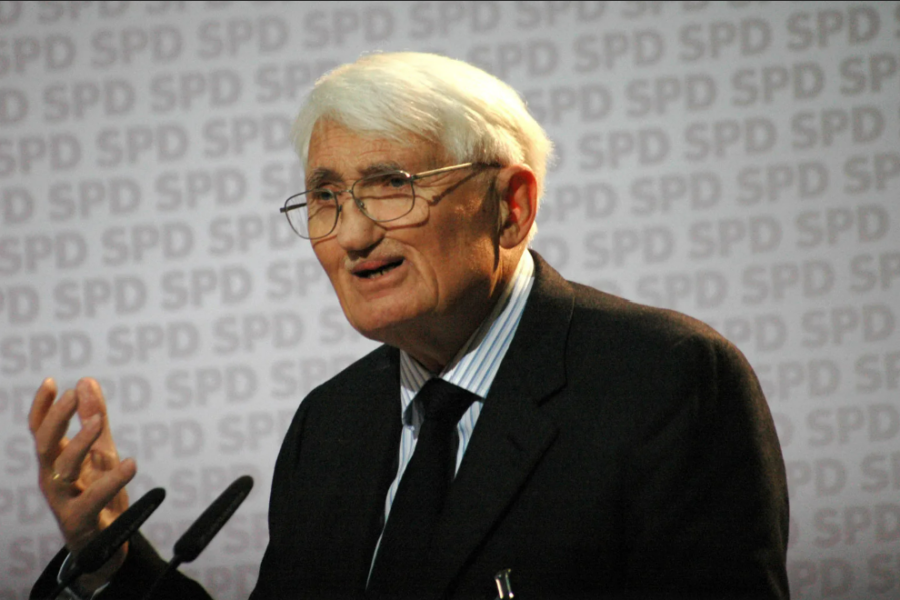
Jürgen Habermas needs little introduction. He is ‘the leading systematic philosopher of our time’, according to one-time contender Richard Rorty. ‘In terms of range and depth there is no one close to him’, says Thomas McCarthy. ‘Habermas has been able to go into discussions … in a dozen different disciplines – and becomes one of the dominant voices in each one’.[1] This review essay does not pretend to take Habermas whole; instead of being overwhelmed by the complete orchestra, we will take a few soundings from representative works on the recent key term and theme of ‘post-secularism’ with which Habermas, often named ‘the pope of European secularism’,[2] is now associated.
The terms ‘post-secular’ or ‘post-secularism’ are colloquially captured in the title of God is Back[3] about the recent resurgence in recognition of global public religion. This paper proposes that Habermas’ immense interdisciplinary contributions and journey towards a more post-secular philosophy and sociology provide resources for critically and constructively engaging the more theologically tone-deaf, as well as those with triumphalist notions of post-secularism leaving secularism behind. As a literature review essay, it follows Habermas’ habit of reviewing disciplines and themes and engaging in various dialogues, which become ‘building blocks’ for his own system.[4]
Definitions
Before defining ‘post-secular/ism’, we need to define ‘secular/ism’. For Edward Bailey, ‘Secular … means simply, the opposite of “religious” – whatever that means’.[5] But ‘Since it is impossible to define what is religious in universal terms, the definition of the two terms becomes circular, whereby each is the opposite of the other’.[6]
More specifically, the doyen of secularisation theorists, Peter Berger, defined secularisation as ‘a process in which religion diminishes in importance both in society and in the consciousness of individuals.… [T]he relation between modernity and religion is inverse – the more of the former, the less of the latter…’.[7] However Berger recently edited a mea culpa regarding that standard theory of secularisation, entitled The Desecularization of the World: Resurgent Religion and World Politics.[8]He admits that desecularisation is a more accurate label now considering the massive growth of various ‘furious’, ‘supernaturalist’, ‘fundamentalist’ or ‘conservative’ religious forms over more liberal or mainstream forms previously comfortable in modernity.
Linell E. Cady further unwraps the binary logic of the above categories:
This dominant version of secularism, primarily defined as not-religion, is nestled and sustained – if now more tenuously – within a much larger network of binary oppositions established by its central terms, such as reason and faith, objective fact and subject, and most fundamentally, modernity and tradition.[9]
From within these binaries, Habermas observes logically that ‘A “post-secular” society must at some point have been in a “secular” state’. It therefore applies only to affluent European and British Commonwealth nations where religious practices have declined since World War II. Sociologically, these practices have not re-emerged sufficiently (or at all) to justify the label ‘post-secular’. Trends towards individualised and de-institutionalised spiritualities have not compensated for lost associations with and participation in the major religions.[10]
Habermas notes three key aspects of standard secularisation theory. ‘First, progress in science and technology promotes an anthropocentric understanding of the “disenchanted” world as causal gaps are empirically explained leaving less room for God, the supernatural or metaphysical worldviews.’ ‘Second, with the functional differentiation of social subsystems, the churches and other religious organizations lose their control over law, politics, public welfare, education and science’; thence religion is increasingly privatised. Third, economic development leads to higher human welfare and social security levels; these risk reduction strategies increasingly replace faith in a protective higher power.
However, Habermas now accepts the new sociological critique of the Eurocentredness of these explanations and expectations of a global Europeanisation. The US pattern of vigorous religious growth has replaced the European form of secularism and become the new normal, with European or ‘Occidental rationalism’ (Weber) the exception. ‘Three overlapping phenomena converge to create the impression of a worldwide “resurgence of religion”: the missionary expansion (a), a fundamentalist radicalisation (b), and the political instrumentalisation of the potential for violence innate in many of the world religions (c)’.
Habermas’ critique of the secularisation thesis is measured. He acknowledges the global data is still somewhat supportive, but suggests the thesis’ weakness is due to overconfident predictions based on vague notions of causation equating secularisation and modernisation. He acknowledges that ‘There is a correlation between the functional specification of the religious system [in ritual and pastoral care] and the individualisation of religious practice’. Yet Habermas agrees with Jose Casanova that such specialisation and individualisation do not necessarily imply that religion is irrelevant and uninfluential politically or personally. Contemporary European public consciousness is ‘post-secular’ in having to ‘adjust itself to the continued existence of religious communities in an increasingly secularized environment’.[11]
For Habermas, ‘Post-secular’ refers to a change in mindset mainly due to three phenomena: ‘First, the broad perception of … global conflicts … presented as hinging on religious strife changes public consciousness’. This makes secular Europeans ‘aware of their own relativity within the global horizon’ of religious persistence and renaissance.[12] Second, religious groups are gaining public influence globally and nationally as ‘communities of interpretation’ on public, ‘secular’ issues. Life issues like bioethics or climate change are not pre-settled secularly but depend on who offers ‘more convincing moral intuitions’. Religions are well resourced with these intuitions that sustain public visibility. Third, immigration from traditional religious cultures challenges public consciousness.[13]
Political and Historical Movements Towards Post-Secularism
Eduardo Mendieta describes the terms ‘postsecular society’ and ‘post-metaphysical philosophy’ as terms ‘appropriated’ from his collaborator Klaus Eder.[14] Eder depicts the secular ‘hushing–up’ or privatising of religion, rather than its going away, and its now becoming relatively more vocal and public as a significant post-secular minority. Habermas may not have coined the term post-secular, but the great post-metaphysical philosopher taking up the term gave it considerable credibility. He agreed with Berger’s pinpointing in The Desecularization of the World that ‘Religious traditions and communities of faith have gained new, hitherto unexpected political significance, since the epoch-making historical juncture of 1989-90’. This includes not only the fall of the Berlin Wall (and the catalytic role of John Paul II, Solidarity and East German churches), but the rise of Islam and far-flung fundamentalisms as partly ‘a long-term result of the violent colonization and failed decolonization’ and socially destructive and divisive ‘capitalist modernization’.[15] We could add to Habermas’ list the overthrow by black and global churches of the heretical apartheid of the South African Dutch Reformed Church.
And so, exuberant, publicly engaged religion burst out of the narrow confines of the private and devotional into public space, demonstrating that European secularism is the exception. Habermas proposed a post-secular dialogue between religious and secular contributors involving mutual learning and solidarity.[16] For Habermas, this is not mere sociological description but normative prescription: ‘How should we see ourselves as members of a post-secular society and what must we reciprocally expect … to ensure that … social relations remain civil despite the … plurality of cultures and religious world views?’
To illustrate, the Guardian’s Madeleine Bunting notes the contrast between bourgeois British atheists’ ads on public transport in 2009 with poor immigrants devoutly reading their Bibles on a London bus. David Ley comments: ‘The Habermas model would prefer reflexivity and mutual learning between the parties who claim the inside and the outside of the bus’.[17] This is a key motif of Habermas’ post-secularism.
Processes of Post-Secularity Gaining Attention
Ley laments the ‘“profusion of posts” in contemporary social science’. He asks: ‘is the world indeed changing so rapidly across so many dimensions with such marked discontinuities that we can so confidently mark the end of one era and the start of another? Or are we miscalculating the degree of change…? Could it be that what has changed is the focus of our gaze rather than the things themselves?’[18]
Rather than making fixed, arbitrary and ideological periodisations, Ley sees certain post-secular processes arresting our attention over time. His categories are similar to Habermas’ above: First, ‘In the global north … the neoliberal turn and the stripping down of the welfare state have returned us to a condition where public charity once again is called upon … a calling of faith-based organizations’.[19]
Second is the rise of religious/transcendent terrorism.[20] ‘The War on Terror, and subsequent terrorist events … have focussed attention on militant mutations of world religions … the most spectacular version of a much broader engagement of the greater religious exuberance with a more somnolent spirituality in Europe … and European settlement’ (except the US).
A third process is immigration, which challenges standard secularisation theory. Philip Jenkins highlights immigration’s role in injecting new life into European Islam and Christianity: ‘Both … have real difficulties in surviving within Europe’s secular cultural ambience …. But instead of fading away, both have adapted to Eurosecularity … and they are continuing to adapt’.[21]
Habermasian Soundings on the Way to Post-Secularism
As noted above, Habermas is an illuminating illustration of the broader trend of underlying continuity and developing dialectic between the secular and post-secular, now being given more confident public attention and expression. From reading Habermas’ more religious collections and responses, gathered from their scattered and unsystematised contexts, we agree with Mendieta that Habermas’ relation to religion and his turn to post-secularism is not a sudden ‘temporal rupture’ between negative and positive views of religion, perhaps precipitated by 9/11 or 1989, ‘but an ever present appreciation of religion that fluctuates with the angle of approach, or lens of analysis … whether he is broaching the question from a philosophical and critical … or sociological, political, and legal perspective’.[22]
This could be restated as Habermas having an increasing appreciation of religion, though still often strongly rationalistic. For instance, his over fifty-year-old genealogical survey of The Structural Transformation of the Public Sphere: An Inquiry into a Category of Bourgeois Society[23] depicted the rise and fall of the middle class public sphere as a space for the ‘uncoerced force’ of reason, always seeking the best argument. Here Craig Calhoun, editor of Habermas and the Public Sphere, noted Habermas’ ‘neglect of religion’ and of religious influence on the bourgeois, something Habermas later acknowledged in that same book.[24]
More seriously, Habermas’ ‘antireligious assumptions’, ‘methodological atheism’ and uncompromising statement that since Hegel there has been ‘no alternative to postmetaphysical thinking’[25] inhibited post-secular dialogue until the mid-1990s.[26] However his more recently translated Postmetaphysical Thinking II,[27] while maintaining continuity, hence the title, challenges fellow post-metaphysical inheritors of the Enlightenment to recognise their own religious roots and to at least have an ‘agnostic’ and ‘receptive’ attitude towards the role of religion in secular society, not an imperialistic, atheistic secularism, but a genuine dialogue.[28]
We now take some earlier and later soundings from Habermas in relation to the larger process of post-secularity.
The Influence of the Frankfurt School’s ‘Non-Secular Secularism’ (1954-1971)
In Habermas’s work until the mid-1990s, there were few systematic works on religion. Yet his first doctorate, Das Absolute und die Geschichte (1954), examines Schilling’s use of Isaac Luria’s Jewish concept of zimsum or divine self‘contraction’, whereby the Creator opens up within himself a ‘capacity for self-limitation’. This provides, in a sense, ‘secular’ space for the contingency of creation, human freedom and a costly ‘theodicy’, in a final, though deferred, judgement and redemptive age, for both humanity and God.[29]
Habermas’s Frankfurt School forerunners, such as Max Horkeimer and Theodor Adorno, with their strongly Jewish, ‘secular, apocalyptic, utopian and pessimistic messianism’, had ‘a sustained and in-depth concern with questions of religion, theological metaphysics, and the history of religious ideas’. This was described paradoxically by Gershom Scholem as ‘non-secular secularist’.[30] Their negative theology sought to salvage religious remnants to negate a poisonous scientific positivism and intellectual idolatry. Horkheimer’s essay for Adorno’s Festschrift contains the key statement, ‘Without God one will try in vain to preserve absolute meaning. … The death of God is also the death of eternal truth’.[31]
The apparent ‘secularity’ of the Frankfurt School seeks to abolish the false absolutes of Nazism and its fellow travellers, not sacralise them. For Horkheimer, religion is a form of resistance to all idols. In Horkheimer and Adorno’s Frankfurt School approach, religion ‘is a fundamental concept of the dialectic. That we cannot say anything absolutely about God is assimilated into one of Critical Theory’s foundational presuppositions: that the absolute is unrepresentable’.[32] More positively, Habermas later states that, ‘Philosophically, the powerful cognitive impulse behind the Axial Age is captured in the First Commandment, namely, emancipation from the chains of lineage and the arbitrary will of the mythical powers’.[33]
Adorno critiques
the reificiation of interpersonal relationships and intrapsychic energies as a consequence of the prohibition against images…. Reification is deification; the distortion of something conditioned into the unconditioned. … A subjectivity run amok transforms everything around it into objects, elevating itself into the Absolute, and thereby running up against the true Absolute – against the unconditional right of each creature not to be overlooked, to be acknowledged for what it is. The rage of objectification ignores the essential core of the fully individuated Other, by which the creature is marked as having been made “in the image of God”.[34]
Habermas finds illumination for ‘two aspects of human freedom’ in ‘the myth and … more than just a myth’ of Adam’s failed attempt to ‘topple God Himself from His throne’: ‘the intersubjective constitution of autonomy and … the meaning of the self-binding of the will’s arbitrary freedom to unconditionally valid norms’.[35] This is linked to Habermas’ later turn in 2000 to the Adamic saga for Christianity’s doctrine of the image of God as a bulwark against dystopian technocratic threats to remake humanity itself.[36]
Habermas, like the Jewish and Frankfurt School proscription against fully naming God, is agnostic of any numinous naming, which he believes inevitably turns into idols and ideologies. With Adorno he stands against pre-Axial, neo-pagan tendencies that prepared the way for Nazism and today’s postmodernism. The Young Hegelians’ ‘postmetaphysical’ thought remained profoundly ambiguous. To this day it remains threatened by the possibility of a relapse into ‘neopaganism’.[37]
Habermas’ early interest in religion was primarily ‘from the standpoint of how religion prefigures philosophical concepts’. In several noteworthy essays from the 1950s to the 1960s, ‘while there are some scattered comments about secularization’, the dominant tone is towards seeking religious concepts as a source of indispensable and inexhaustible philosophical light, ironically ‘taking up the Jewish question without the Jews’.[38]
Mendieta introduces Habermas’ Religion and Rationality by stating that Habermas’ ‘methodological atheism’ is not a rejection of but a response to and a dialectical sublation of the Jewish-Christian tradition’ of his predecessors. This essay collection shows Habermas inheriting and transforming the critical tradition of Jewish utopian messianism of the early Frankfurt School. It demonstrates that there is no ‘temporal rupture’ between an anti-religious and pro-religious stage in Habermas.[39]
Communicative Action as Post-Metaphysical Holiness and Transcendence (1971-1982)
Though there is no rupture, there is a shift, in Mendieta’s terms, ‘From A Reconstruction of Historical Materialism toward a Theory of Communicative Action’. This transition is from a Marxist ideological critique culminating in Knowledge and Human Interests (1968 [1971]) ‘to an abandonment of philosophical anthropology and hermeneutics.…’ Habermas moves toward a more democratic, pragmatic ‘theory of social rationalization in terms of systems … and linguistic competences that … track the evolution of societies … and the socialization of competent moral and acting subjects’ in the ‘general presuppositions of communicative action’.[40]
Habermas’ treatment of religion increases in this period but shifts from philosophical to sociological mode. Religious questions are turned into ‘questions of the rationalization of worldviews and social practices’. In the 1970s and 1980s Habermas’ emerging democratic dialogical ethics seeks a philosophy of public, pragmatic reason. This is part of his rejection of those post-metaphysical philosophers who reach back behind the mid first millennium Axial Age to celebrate pagan virtues.
Habermas’ counter to this hubristic Nietzschian, Dionysian paganism is a form of earthy, linguistified, post-metaphysical philosophy. Religion’s socially integrative and sacred function is taken up by secularised communicative reason in his foundational The Theory of Communicative Action (Volume I, English translation, 1984; and Volume II, English translation, 1987): ‘the socially integrative and expressive functions … at first fulfilled by ritual practice pass over to communicative action; the authority of the holy is gradually replaced by the authority of an achieved consensus in submission to the liberal state which imposes rules for secular communicative action’.[41]
This is especially so in The Theory of Communicative Action II, Part V, Ch. 2: ‘The Authority of the Sacred and the Normative Background of Communicative Action’. Habermas shows how early human evolution involves religious worldviews providing an analogical interconnection between God, human society and creation that rationalises and authenticates social connection and ethical authority.
Critical to this connecting role is the process of religious ritual which evolves to linguistify, not merely mystify.
This linguistifying symbolization … catalyzes the very distinctions and opposition (God vs World, God vs Us, God and Us vs others, etc.) that … bring about the linguistification of the sacred. This … is itself the heart of the logic of secularization. … [It] results in the disempowerment and disenchantment of the sacred which in turn unleashes the normatively binding power stored in ritualistically achieved fundamental agreements [or covenants]. Both the cowering fear and uplifting love of the terrifying and spellbinding omnipotent God are sublimated in the binding/bonding power of communicative action.[42]
Critical to this is the socialising process of religious ritual:
The core of collective consciousness is a normative consensus established and regenerated in the ritual practices of a community of believers. Members thereby orient themselves to religious symbols; the intersubjective unity of the collective presents to them in concepts of the holy. This collective identity defines the circles of…members…The rites can be comprehended as residues of a stage of communication…already…gone beyond in domains of profane social cooperation.[43]
Thus, in a somewhat Whiggish view, religious ritual evolves to linguistify secular cooperation, not merely mystify the sacred. To Habermas, at this stage language provides the critical disenchanting power beloved of standard secularisation theory, running parallel with modernisation.
For Mendieta, this is ‘the life vein of Habermas’ entire system of thought: “What raises us out of nature is the only thing whose nature we can know: language. Through its structure, autonomy and responsibility are posited for us” … expressing“unequivocally the intention of universal and unconstrained consensus” … the core of his theory of communicative rationality’.[44] But Mendieta rightly questions the ambiguity of the analysis: ‘Has religion been totally absorbed into the norms of social interaction, leaving nothing behind but the memory of ecstatic rituals and the empty pedestals of exiled gods?’[45]
Further, Maeve Cooke’s careful study of Habermas’ conception of the good society claims that his ‘ideal speech situation, or more generally, of a communicative rationalized life-world, does not merely evoke a picture of a … specific social condition; they conjure a picture of a society that transcends the contingencies of human life and history and in which human finitude would have been overcome’.[46] A key area for exploration is how a biblical anthropology of finite humans imaging God might link with Habermas’ linguistic ‘life vein’ that leads to him being called ‘The Theologian of Talk’.[47]
‘Postmetaphysical Thinking and Deliberative Democracy’[48] (1982-1992)
In this decade Habermas returns to philosophy in The Philosophical Discourse of Modernity (1985 [1990]), from Hegel to Foucault, in parallel with his major revision of social theory in The Theory of Communicative Action (1981 [1984, 1987]). Philosophy is no longer queen of the sciences nor handmaiden to theology. She is a ‘placeholder’, discerning amongst different scientific theories.
In Mendieta’s apt terms: ‘The linguistification of reason meant that philosophy would have to recognise that reason had become historicised, become procedural, … been de-transcendentalized and thus dispossessed of exorbitant claims about the extraordinary or transcendent’. In his Postmetaphysical Thinking ([1988] 1992)Habermas profiles this more modest role for philosophical reason ‘in its mundane embodiment as communicative action’.[49]
Habermas makes a strong distinction between personal, historical lifeworld and the instrumentally rationalised systems colonising more and more of that world. This demands increasingly rational agents and new personality types and psychological structures. Such a de-traditionalising of society leads to a ‘postconventional moral and psychological orientation’. Individual and private questions of the good life and worldview are subsumed under the demands of everyday universalised justice in our interactions with other rational subjects.[50]
Hence, Habermas’ moves towards moral philosophy are an expression of a linguistified reason he increasingly applied to general post-metaphysical reform. Now Kant’s categorical imperative and its axioms are redeveloped through communicative action, and its two principles of universalisation – U: serving the satisfaction of all interests; and D: discourse norms – are only valid if they meet or can find the approval of all those affected in their role as participants in practical discourse.[51]
Habermas’ focus on moral norms and ethical contents in Between Facts and Norms ([1992] 1998) shifted his attention again towards religion in search of richer normative resources to resist complete systemic colonisation of the life-world. One key essay emerges from a conference at the University of Chicago Divinity School in 1988 entitled ‘Transcendence from Within, Transcendence in This World’. Here he engages as a distant ‘methodological atheist’ yet in sympathy with the normative questions of theologians.
Religious language is related in Habermas to ritual practices that are ‘limited’ in comparison with ‘profane everyday praxis’ in its ‘freedom of communication’. From his fallibilist perspective, faith is protected against radical questioning or by being ‘rooted in cult’ and ‘unquestioned metaphysics’, that ‘has been dissolved in the acids of modernity’. Hence, even theological arguments must submit to ‘expert culture’ for adjudication.[52] But this sounds too much like the positivist scientific neutrality of experts that Habermas rejects elsewhere,[53] following his Frankfurt fathers.
Early in his engagement with theologians, Habermas himself sounds out of his depth in another’s expert culture.[54] In criticising theology’s claim to ‘the indispensability of a transcendent Other’, he succumbs to grandiosity in claiming the unconditionality or transcendence within this-worldy, intrasubjective language:
As agents of communicative action, we are exposed to a transcendence … integrated in the linguistic conditions of reproduction without being delivered up to it. This production can hardly be identified with the productivist illusion of a species that generates itself and which puts itself in the place of a disavowed Absolute. Linguistic intersubjectivity goes beyond the subjects without putting them in bondage … it is not a higher-level subjectivity and therefore, without sacrificing a transcendence from within, it can do without the concept of an Absolute. We can dispense with this legacy of Hellenized Christianity and … any subsequent right – Hegelian constructions.[55]
Mendieta notes that language is not a God-replacement unifying all things, ‘an onto-metaphysical substratum’, nor absolute determiner of subjective relations. ‘Even as post-metaphysical thinking dispenses with God as a onto-metaphysical referent, it retains the insight of a normative claim that constrains as it frees, for, as created creatures, we nonetheless remain utterly free.’[56]
Habermas repeats the anti-metaphysical transcendence argument in another essay on Horkheimer’s late religious turn, where he claims that the ‘critical task of philosophy consisted entirely in salvaging religion in the spirit of the Enlightenment’. But that is an impossible task as the secularisation of religion means its end.[57]
Horkheimer honoured the more consistent sceptical thinkers who saw ‘the impossibility of deriving from reason any fundamental argument against murder’. For Habermas, such aphoristic comments affirm that it is ‘vain to strive for unconditional meaning without God’. He affirms Horkheimer’s outline of the task to salvage religion but denies Horkheimer’s identification of the unconditional Absolute with a transcendent God. Instead, again, unconditionality lies in a linguistic structure that stretches us beyond ourselves. ‘Whoever employs language with a view to reaching understanding lays himself open to a transcendence from within…. Linguistic intentionality outstrips subjects without subjugating them.’ Post-metaphysical thought parts ways ‘from religion in that it recovers the meaning of the unconditional without recourse to God or an Absolute.’[58]
Yet Habermas increasingly recognises that this linguistic unconditionality may be different to that of religion’s irreplaceable ability to provide motivation and meaning, to bring ‘consolation and even reprieve in the face of unmerited suffering and anguish’.[59] The air still hangs thick with the smoke of the Holocaust for Habermas.
Mutual Translation to Preserve Human Transcendence in the Secular Sphere (1990s-2000s)
Habermas increasingly realises in the 1990s and 2000s the reality and fragility of human communications and multi-religious pluralism in a tectonically shifting technologised society. Secular societies that try to understand and translate their religious traditions of transcendence ‘which point beyond the human realm will also be able to rescue the substance of the human’.[60]
This humanising thrust of religious anthropologies emerges more fully during debates regarding the nature of the human in bioethics and genetics around 2000. Here Habermas explicitly affirms the significance of the Judeo-Christian view of humanity made in God’s image and the significance of the doctrine of creation for limiting utopian post-humanist and technological self-transformation. Again, Nazi (and other western) eugenics are part of the dark background to his views and fears, as is his rejection of positivist, fundamentalist scientism and technocracy. This is also in part Habermas’ response to the loss of the secularisation thesis’ plausibility and the mutual need of religion and secular society to share thicker traditional and linguistic resources for meaningful moral discourse.[61]
Secular reciprocation with religion was not originated in 9/11, but was reinforced and accelerated by it. Rather than dismissing all religions as terrorists or poison-pedlars in the public realm as new atheists did, or as deterministic civilisational forces of violence as Samuel Huntington did in The Clash of Civilizations,[62] Habermas became increasingly open to the priority of dialogue between secular and religious thinkers and between world religions. However, religions need to translate their languages into accessible secular-speak for public legislative purposes. Correspondingly, secularists should dialogue with religionists in the new ‘post-secular’ space through a process of mutual translation that goes well beyond Rawls’ paternalistic proviso of one-sided public translation by the religious.
Habermas previously designated religious language as ‘awkward’, ‘opaque’, ‘dogmatically encapsulated’, lacking secular ‘general accessibility’ and being too dependent on revelation and dogma. But he hastily ‘conflates religious arguments with authoritarian arguments’.[63] ‘Habermas’ own lucid interpretation of the doctrine of creation … shows that these features do not always apply’, as Maureen Junker-Kelly argues. She also applauds Habermas’ renewed stress on monotheistic Creation, not [Platonic] Emanation, as the key precipitating factor of human freedom. In fact, for Habermas, ‘This creational nature of the image … expresses an intuition which…may even speak to those … tone-deaf to religious connotations’. It is the biblical ‘image’ language that provides the indispensable background for secular human dignity and rights language without ‘dissolving’ into dignity discourse, exemplifying mutual translation.[64]
Contrary to John Rawls’ proviso that religionists must cast out comprehensive doctrines from entry into public debates, Habermas defends their right to use religious language in such debates, with the exception of specific legislation and corporate cultural rights. Rawls’ ‘proper political reasons’ are not required for public dialogue, just an openness to mutual translation. As Junker-Kenny states, ‘Habermas displays a theological literacy unmatched by his fellow-liberal John Rawls’.[65]
Post-Secular Conversations Between Naturalism and Religion (2000-2005)
Habermas is an engaged public intellectual. To paraphrase Barth, Habermas has a (post-metaphysical) philosophy book in the one hand and a newspaper in the other. 9/11 could not go unnoticed or un-commented upon by him. He soon wrote of his long struggle to articulate the dialectic between ‘Faith and Knowledge’ in seeking a mutually respectful democratic conversation in a pluralist, global, de-secularising world. For Habermas, anyone ‘who wants to avoid a clash of civilizations must call to mind the dialectic of our occidental process of secularization is not yet closed’.[66] Habermas thus agrees with aspects of desecularisation theory. Religion is resilient and rumours of its death are premature.
Henceforth Habermas modifies John Rawls’ one-sided secularism and some of his own by stressing a more mutual learning and translation process between the secular and religious. Contrary to Rawls’ famous proviso of keeping religious reasons private in both the informal and formal political spheres, Habermas now argues that ‘A liberal political culture can even expect of its secularized citizens that they participate in efforts to translate contributions from the religious language into a publicly intelligible language’.[67] Whether this is possible, it is a noble attempt at a win-win – not a knock-out punch, but an ongoing wrestling of secular and religious for mutual understanding.
In his essay collection from 2000 to 2005, Between Naturalism and Religion,[68] Habermas explores the post-metaphysical space between mutually destructive religious and naturalist fundamentalisms. Having approached religion through various lenses – philosophy, sociology, ethics – he now deepens political science to clarify relations between religion and democracy in dialogue with Cardinal Ratzinger in 2004. Habermas connects post-metaphysical philosophy and post-secular society in Ch. 4: ‘Prepolitical Foundations of the Constitutional State’. He does so in order to answer Bockenforde’s challenging 1960s question, especially for secular pluralist states, of whether constitutional states are self-renewing or need religious and other resources of ‘normative infrastructure’ and motivation beyond mere positive law, something the Nazis claimed legitimated genocide.
Habermas states that: 1. Pluralism is unlikely to be stabilised sufficiently and motivationally on a merely formal positivist platform of procedural justice; 2. Liberal societies depend upon citizens’ solidarity, ‘whose sources could dry up’ through ‘uncontrolled secularization’; 3. Religions shouldn’t gain an undeserved benefit from helping to provide this motivational input; 4. We see ‘social and cultural secularization as a twofold learning process that compels the traditions of the enlightenment and religious teachings to recognise each other’s limits’; and 5. ‘Post-secular societies’ should ask of both religionists and non-religionists ‘what cognitive attitudes and normative expectations’ should be required of both groups in civil society.[69] These pre-political pre-requisites are required for sustainable social conversation and cooperation beyond the extremes of either political theology à la Strauss or absolutist secularism.
In ‘Religion in the Public Sphere’ (Ch. 5), Habermas challenges Rawls’ modified proviso with a growing concern for pluralism, ‘developed from his “Theory of Justice” into “Political Liberalism”’. Rawls still restricts religious reasons in public debate as an ‘overly narrow secularist definition of the political role of religion within the context of a liberal political order’. Habermas takes seriously Rawls’ critical but insufficiently answered question: ‘How is it possible … for those of faith … to endorse a constitutional regime even when their comprehensive doctrines may not prosper under it, and indeed decline.’ Rawls is overly determined to ensure that religious public debaters ‘are not puppets manipulated from behind the [secular] scenes by comprehensive doctrines’. He is unconscious that this leaves the stage to secularist ‘comprehensive doctrines’.[70] Religious public actors must effectively echo the secular stage whisperer[71] or be never-endingly nimble at switching from their internally held comprehensive doctrines to secularist public justifications, akin to bad faith or relinquishing conscience for some.
From the Translatable to the Untranslatable Transcendent (2004-2007)
This secular-religious mutuality is famously furthered in Habermas’ 2004 Munich moment with then Cardinal Ratzinger. Habermas at first exhorted religions to contribute to public dialogue through fair processes and clear translation, not relying on aces of authority up their sleeves allowing them to dictate democratic procedures. But he increasingly saw that democracy depends on citizens’ moral formation and a range of pre-moral intuitions and memories of human fragility, suffering and grief.[72] These are often religiously inspired, often untranslatable,[73] yet motivate ‘mentalities of solidarity’.[74]
Later, at Regensburg in 2006, the now Benedict XVI’s controversial address affirmed Europe’s Christian heritage against the rising tide of Islamist violence and the broader threat of religious and moral relativism. Benedict built on the double meaning of Logos as reason and word in John 1:1, joining the Hellenistic and Hebraic within Scripture – not, as Harnack and Habermas thought, a belated imposition dividing philosophy and theology. To Benedict XVI, this divine self-communication or revelational ‘encounter between Athens and Jerusalem takes place already within the Bible’.[75] Benedict’s integration of theology and philosophy challenges the narrowness of modern positivistic scientism and the postmodern breadth of relativism.
Habermas opposes both extremes but from a post-metaphysical and scientific entry point. He had already accepted that his view ‘of language and of communicative action oriented toward mutual understanding nourishes itself from the legacy of Christianity’. ‘The “telos” of reaching understanding – the concept of discursively directed agreement which measures itself against the standard of intersubjective recognition, that is, the double negation of criticisable validity claims – may well nourish itself from the heritage of a logos understood as Christian … embodied … in the communicative practice of the religious congregation.’ Habermas has shifted from his previous secularist prejudice against allegedly indisputable religious dogma. Perhaps he might have discovered this earlier in the Jewish tradition of chutzpah derived from Abraham’s bold question: ‘shall not the Judge of all the earth do what is just?’ (Genesis 18:25, NRSV). Habermas’ reading of Aquinas also impressed him, perhaps not least Aquinas’ disputational method of reasoning.
Further, Habermas’ genealogy of rational public discourse now stretches way past the Enlightenment and late medieval nominalists to what he now sees, along with Jaspers, Bellah and Taylor, as the Axial Revolution of world views in the mid-first millennium BCE as the shared origin of philosophy and religion, reason and faith.[76] Despite secular reason often finding religious reason opaque, its encounter with it ‘can sharpen post-secular society’s awareness of the unexpected force of religious traditions’.[77] This is Habermas’ way forward for societies experiencing resurgent global religion.
But for all their shared concern for mutual enrichment of faith and reason, Benedict XVI ‘resists the power of the arguments that shattered that [pre-enlightenment] worldview synthesis’. But Habermas has a post-metaphysical and scientifically prioritised view of such integration.[78] For him,
the religious side must accept the authority of ‘natural’ reason as the fallible results of the institutionalised sciences and the basic principles of universalistic egalitarianism in law and morality. Conversely, secular reason may not set itself up as the judge concerning truths of faith, even though it finally can accept as reasonable only what it can translate into its own, in principle, universally accessible discourses.[79]
Habermas and Benedict are at one regarding faith not being assimilated into reason. Yet the theological ‘self-communicating origin of our reason, and what makes it in principle receptive, must remain … strangely alien, indeed ultimately even unintelligible for the enlightened, “postmetaphysical” reason to which Habermas is wedded’. In Reder and Schmidt’s eyes this should spur theologians on to provide a reasonable explanation of what the unassimilation of faith by reason means.[80]
Habermas seeks a middle way between increasingly militant religions and militant naturalism. The title chapter of the book of his 2007 dialogue with the Munich Jesuits, An Awareness of What is Missing, echoes the post-religious lament of his Jewish Marxist elders in the Frankfurt School – Adorno, Bloch, Horkheimer and Brecht – that there is something missing, a messianic, utopian dimension to communal history.[81] This is related yet different to the more Romantic dimension of what Habermas’ interlocutor Charles Taylor calls the quest for fullness, for meaning.[82]
Habermas tries to steer between the Scylla of an in-principle, untranslatable Radical Orthodox political theology, influenced, in his view, by Carl Schmitt, and the Charybdis of a narrowly restrictive scientism or secularism. He proposes a revised epistemological genealogy of the relationship between religious and modern scientific knowledge. ‘Is … modern science fully understandable in its own terms? Does it provide the performative yardstick of all truth and falsehood? Or should it rather be understood as the outcome of a history of reason of which world religions are an integral part?’ Habermas now sees the latter question as an open one and believes that a mutual relationship between faith and knowledge enables believers and non-believers ‘to treat one another in a self-reflective manner in the political arena’.[83]
Habermas’ Post-Metaphysical Philosophy vs Milbank’s Restored Metaphysics (2005-13)
Yet Habermas still struggles to reconcile his new openness with aspects of his Kantian post-metaphysical system. Like Kant, but more so, he sees the horizontal (practical morality) and vertical (religion) as separate spheres and religion as beyond philosophical verification. He writes a significant justification of his post-metaphysical approach in ‘The Boundary between Faith and Knowledge: On the Reception and Contemporary Importance of Kant’s Philosophy of Religion’.[84] Habermas, though strongly Kantian, is not uncritically so. He attacks Kant’s over-broad incorporation of theistic belief into the justification of practical morality.
Kant’s basic contradiction is that of treating ‘religion both as a heritage and as an opponent’ – as a source of rational, practical morality and, as far as it seeks rational proof for itself, as obscurantist zealotry, requiring philosophical purification. For Habermas, ‘Reason cannot have its religious cake and eat it. Nevertheless, [from] the constructive intention of Kant’s philosophy of religion … we can learn from the articulatory power of the major world religions for the practical use of reason under the conditions of post-metaphysical thinking’.[85]
Habermas uses ‘postmetaphysical’, not only methodologically, concerning procedures and concepts, but also substantially,
to describe agnostic [as opposed to his previous atheist] positions that make a sharp distinction between belief and knowledge without assuming the validity of a particular religion (… modern apologetics) or without denying the possible cognitive content of these traditions (… scientism). Here I … distinguish between rationalist approaches that (in the Hegelian tradition) subsume … the substance of faith into the philosophical concept, from dialogical approaches that (following Karl Jaspers) adopt a critical attitude towards religious traditions while… being open to learning from them.
This he sets against some post-metaphysical and postmodern philosophers returning to pre-Axial Age neopagan myths and irrationality.[86]
There are many interlocutors for Habermas, most comprehensively gathered in Habermas and Religion (2012). Of these, John Milbank stands in starkest contrast to Habermas theologically and philosophically. The staunch opponent of secularism in social theory, and founder of Radical Orthodoxy, tackles Habermas head-on in Ch. 14: ‘What Lacks is Feeling: Hume versus Kant and Habermas’. Despite sympathy with Habermas’ postsecularity, Milbank critiques his sharp divide between faith and reason, due to a presumed non-surpassability of Kantian postmetaphysics.
Milbank sees Habermas as misunderstanding both Pope Benedict XVI’s revival of a metaphysical mediation between faith and reason and newly over-extended ontological naturalism as violations of ‘the limits of pure reason’.[87] Habermas’ post-metaphysical philosophy ‘is already outdated in the face of a manifest revival of metaphysics and … both a revived blend of Greek reason with biblical faith and an ambitious naturalism are coherent, though rival programs. Either idiom … permits a much greater mediation between faith and reason than Habermas allows, … especially in terms of the role given to feeling’. Adapting Hume positively, Milbank argues, contra Kant, that reason as ‘a form of tempered feeling’[88] mediates faith and reason more constructively than Habermas’ ‘pragmatized transcendentalism’ that fails as an intended ‘bulwark against anti-humanist reduction’.[89]
In the same volume, Hent de Vries offers a similarly more holistic and imaginative alternative to Habermas, but from a more global religions base than Milbank. Post-secular is ‘tenuously tied’ to Habermas’ rationally tight and transcendentally light postmetaphysics. Postmetaphysics is perhaps too time-bound and restrictively rational, limiting access to the wide-ranging religiously-inspired political options and imaginations in the global archive.[90]
Conclusion
Milbank, from a more Catholic, Wolterstorff from a more Reformed and Butler from a more secular Jewish perspective, and others like de Vries, raise legitimate questions regarding the compatibility of Habermas’ universalistic post-metaphysical philosophy with his post-secularism. There are some remaining Habermasian post-metaphysical roadblocks to religious rational ratification, such as the unnuanced language of scientific ‘neutrality’ and ‘monopoly of factual knowledge’.[91] These stand in tension with Habermas’ commitment to deliberative democracy and dialogical communication and his, and the Frankfurt School’s, earlier rejection of positivism. He expects religious and secular people to show a mutual willingness to translate their arguments into the other’s languages. But there is still considerable discussion from both sides, and within each side, of whether some lose more than others from translation into an ethical Esperanto.
Habermas’ concept of the post-secular is related to cultural and ethical crises. One factor is the recognition that religions are growing demographically in the majority world, and by immigration and partly in political and social influence in the western world, perhaps emboldened by Islam. Modern societies should prepare for dealing with religions for good.
Economic globalisation without sufficient ethical globalisation is another critical factor correlated to the need for the postsecular for Habermas. He sees an ‘unmastered dynamics’ of the global economy not yet matched by global governance processes. Modernity seems to be ‘spinning out of control’. Motivational sources could erode due to ‘“uncontrolled” secularization of society as a whole’.[92] The resilience and relevance of religious language and ritual may be restorative factors.
However, when global religions are seen in the light of such moral panics, religion can easily be instrumentalised in classical Enlightenment form as a way to stop the mob from panicking or picking the pockets of the rich. Habermas’ functional definition of religion as a moral resource for democratic negotiation is better than Huntington’s The Clash of Civilizations,which sees religions primarily as potential sources of conflict, but it can fall into the same instrumentalist trap.
Nonetheless, elsewhere Habermas notes the ritual significance of, for instance, funerals in shaping a culture, dealing with life’s contingencies and relating transcendence and immanence, as some of religion’s many functions.[93] For the political philosopher Habermas, religion is not merely moralistic, motivating ideal public negotiation processes in a narrow and formal way; it is also an ethical norm and virtue producing telos for individuals and communities.[94]
Some final questions to pose to Habermas’ post-metaphysical morality of Kantian practical reason and deontological ethics: Is it is a flat-earthed secularism primarily critical of Christian metaphysics? Or is its nemesis more broadly Greek and particularly platonically-influenced pre-Kantian metaphysical philosophy? Or is it, given the earlier Jewish background of the Frankfurt School, more iconoclastic, trimming the sails of all metaphysical philosophical hubris, sacred and secular, as idolatry? From our various soundings it appears that Habermas has moved over time from a more strictly secular approach, though with various post-secular religious resources lying dormant, ready to be re-awakened as times changed, from 1989 on becoming more open to notions of perennial public and global religion.
Gordon Preece is Director of Ethos and former Director of three tertiary ethics centres, lead minister of two Anglican parishes and Director and Senior Policy Officer of Baptist and Catholic social ministries. His dozen books, both single-authored and edited, include books on work in a precarious world, and on major figures like Peter Singer and Dietrich Bonhoeffer. He has written over a hundred articles on sexuality, bioethics, postmodernity and mission in the post-Christendom world. He is married to Susan and has three adult children and five grandchildren.
This paper has been double blind peer reviewed. It was first published in Zadok Papers S263 in Summer 2022.
[1] Mitchell Stephens, ‘The Theologian of Talk’, Los Angeles Times Magazine, 23rd October 1994, latimes.com/archives/la-xpm-1994-10-23-tm-53927-story.html.
[2] Cited in Robert Bellah’s back cover blurb of Habermas and Religion, edsCraig Calhoun, Eduardo Mendieta and Jonathan VanAntwerpen(Cambridge, UK: Polity, 2013).
[3] John Micklethwaite and Adrian Wooldridge, God is Back: How the Global Revival of Faith is Changing the World (New York: Penguin, 2009).
[4] Eduardo Mendieta, ‘Appendix: Religion in Habermas’s Work’, in Calhoun et al., Habermas and Religion, 391.
[5] Quoted in Willard H. Swatos, Jr., ‘Secularization Theory: The Course of a Concept’, Sociology of Religion 60, no. 3 (Fall 1999), 213.
[6] Abdullahi Ahmed An-Na’im, ‘Islam and Secularism’, in Comparative Secularisms in a Global Age, eds Linelle E. Cady and Elizabeth Shakman Hurd(New York: Palgrave MacMillan, 2010), 217. Cf. An-Na’im’s useful distinction between soft secularism in the US and UK and hard secularism (or laïcité) in France and (pre-Erdogan) Turkey. Habermas makes a similar distinction but between the sociological description of secularity and secularism as ideology.
[7] Peter L. Berger, ‘Secularization and De-Secularization’, in Religions in the Modern World: Traditions and Transformations, eds Linda Woodhead, Christopher Partridge and Hiroko Kawanami (London: Routledge, 2002), 291-298 (especially 291 for quote).
[8] Grand Rapids, MI: Eerdmans, 1999.
[9] Linelle E. Cady, ‘Reading Secularism Through a Theological Lens’, in Cady and Hurd, Comparative Secularisms, 247.
[10] This paragraph and the rest of this section are drawn from Jürgen Habermas, ‘Notes on a post-secular society’, Sign and Sight, 18th June 2008, signandsight.com/features/1714.html. Compare recent Australian debates regarding the rapidly rising ‘No Religion’ category in the 2016 Census as to how many non-religious but spiritual people it included. See Gary D. Bouma, ‘“No religion” and Jedi Knight find their place in Australian identity’, theconversation.com, 23rd August 2017. Contrast the global picture where, ‘as a share of all people in the world, religious “nones” are projected to decline from 16% of the total population in 2015 to 13% in 2060. While the unaffiliated are expected to continue to increase as a share of the population in much of Europe and North America, people with no religion will decline as a share of the population in Asia, where 75% of the world’s religious “nones” live’. See ‘The Changing Global Religious Landscape’, Pew Research Center, 5th April 2017, assets.pewresearch.org/wp-content/uploads/sites/11/2017/04/07092755/FULL-REPORT-WITH-APPENDIXES-A-AND-B-APRIL-3.pdf.
[11] Compare Justin Beaumont: ‘It … does not infer that we now live in a radically different age compared with half a century ago … We consider postsecular as the indication of diverse religious, humanist and secularist positionalities – and not merely an assumption of complete and total secularization’. In Exploring the Postsecular,eds Arie L. Molendijk, Justin Beaumont and Christoph Jedan (Boston/Leiden: Brill, 2010), 6.
[12] Compare Charles Taylor, A Secular Age (Cambridge, MA: Belknap, 2007), Ch. 16, on the ‘Cross-Pressures’ of secularists and religionists on each other. Habermas may exemplify cross-pressuring from increasing dialogue with many global religious believers. I thank an anonymous reviewer for this point.
[13] This whole section is drawn from J. Habermas, ‘Notes on a post-secular society’.
[14] Mendieta, ‘Appendix’, in Calhoun et al., Habermas and Religion, 404. See Klaus Eder, ‘Post-secularism: A Return to the Public Sphere’, eurozine.com/post-secularism-a-return-to-the-public-sphere,17th August 2006; and Paul Cloke, ‘Emerging Postsecular Rapprochement in the Contemporary City’, in Post-Secular-Cities, eds Justin Beaumontand Christopher Bake (London/New York: Continuum, 2011),338-340.
[15] ‘Religion in the Public Sphere: Cognitive Presuppositions for the “Public Use of Reason” by Religious and Secular Citizens’, Ch. 5 in J. Habermas, Between Naturalism and Religion: Philosophical Essays, trans. Ciaran Cronin (Cambridge, UK: Polity, 2008), 114–115.
[16] Habermas, ‘Religion in the Public Sphere’, 116, 119.
[17] David Ley, ‘Preface: Towards the Postsecular City’, in Beaumont and Baker, Postsecular Cities, xiii-xiv.
[18] Ley, ‘Preface’, xii-xiii.
[19] Cf. Elmar Rieger and Stephan Liebfried, The Limits to Globalization (Cambridge, UK: Polity, 2003), especially Ch. 5: ‘The Welfare State in East Asia: Religion and Globalization’, including section 4: ‘Religious Roots as Driving Forces of Welfare State Development’, 241-335.
[20] My term for what Taylor sees as an expression of ecstatic violence. See the sections ‘The Roots of Violence’ and ‘Misanthropy and Violence’ in his A Secular Age, 656-710.
[21] God’s Continent: Christianity, Islam and Europe’s Religious Crisis (New York: Oxford University Press, 2007), 3.
[22] Eduardo Mendieta, ‘Introduction’, in J. Habermas, Religion and Rationality: Essays on Reason, God and Modernity (Cambridge, UK: Polity, 2002), 2-3.
[23] Cambridge, MA: MIT, 1989.
[24] Cambridge, MA: MIT, 1992, ‘Introduction’, 3536, and Habermas’ ‘Further Reflections on the Public Sphere’ and ‘Concluding Remarks’.
[25] Postmetaphysical Thinking (Cambridge, MA: MIT, 1992), 29.
[26] Cf. Taylor’s ‘immanent frame’ and ‘exclusive humanism’ categories in A Secular Age, Ch. 15 and pp. 19-21, which would include this stage of Habermas’ thought.
[27] Oxford, UK: Polity, 2017.
[28] Drawing on Mendieta, ‘Appendix’, in Calhoun et al., Habermas and Religion, 404-406. Compare the citations by Nicholas Wolterstorff in ‘An Engagement with Jürgen Habermas on Postmetaphysical Philosophy, Religion and Political Dialogue’, Ch. 4 in Calhoun et al., Habermas and Religion, 420.
[29] Habermas, Religion and Rationality, 160-161. A synthesis of the PhD is available as ‘Dialectical Idealism in Transition to Materialism: Schelling’s Idea of a Contraction of God and its Consequences for the Philosophy of History’, in The New Schelling,eds Judith Norman and Alistair Welchman (London/New York: Continuum, 2004), 43-89. For Mendieta, ‘This essay remains key for any in-depth understanding of Habermas’ overall work on religion’, in ‘Notes and References’ in Calhoun et al., Habermas and Religion, 463, n.4.
[30] Mendieta, ‘Introduction’, in Habermas, Religion and Rationality, 5, cf. 6, n.18.
[31] Max Horkheimer, ‘Theism and Atheism’, Diogenes 12, no. 48 (1964), 39-52, now in Critique of Instrumental Reason (London: Continuum, 1974). Note Habermas’ essay title in his Religion and Rationality: ‘To Seek to Salvage an Unconditional Meaning without God is a Futile Undertaking: Reflections on a Remark of Max Horkheimer’.
[32] Mendieta, ‘Introduction’, in Habermas, Religion and Rationality, 7, cf. 8-9 on Adorno.
[33] Habermas, Religion and Rationality, 158-159.
[34] Habermas, Religion and Rationality, 158.
[35] Habermas, Religion and Rationality, 161.
[36] The Future of Human Nature (Cambridge, UK: Polity, 2001 [2003]).
[37] Habermas, Religion and Rationality, 159.
[38] Habermas, Religion and Rationality, 58, cited by Mendieta in ‘Appendix’, 394.
[39] Mendieta, ‘Introduction’, in Habermas, Religion and Rationality, 2.
[40] Mendieta, ‘Appendix’, in Calhoun et al., Habermas and Religion, 395.
[41] The Theory of Communicative Action, Vol. II (Boston: Beacon, 1987), 77.
[42] Mendieta, ‘Appendix’, in Calhoun et al., Habermas and Religion, 397-398.
[43] Habermas, The Theory of Communicative Action, Vol. II, 2.60.
[44] Mendieta, ‘Appendix’, in Calhoun et al., Habermas and Religion, 394, citing J. Habermas, Knowledge and Human Interests (Boston: Beacon Press, 1968), 314.
[45] Mendieta, ‘Appendix’, in Calhoun et al., Habermas and Religion, 398.
[46] Maeve Cooke, Re-Presenting the Good Society (Boston: MIT, 2007), 166.
[47] Stephens, ‘The Theologian of Talk’.
[48] Mendieta’s helpful summary title, in Calhoun et al., Habermas and Religion, 388. Other titles I’ve adapted from his.
[49] Mendieta, ‘Appendix’, in Calhoun et al., Habermas and Religion, 399.
[50] Mendieta, ‘Appendix’, in Calhoun et al., Habermas and Religion, 400.
[51] Moral Consciousness and Communicative Action (Cambridge MA: MIT, [1983] 1990), 65-66.
[52] Mendieta, ‘Appendix’, in Calhoun et al., Habermas and Religion, 402.
[53] Habermas, ‘Introduction’, in Between Naturalism and Religion, 4-6.
[54] Habermas, Religion and Rationality, 67.
[55] Habermas, Religion and Rationality, 91.
[56] Mendieta, ‘Appendix’, in Calhoun et al., Habermas and Religion, 402.
[57] ‘To Seek to Salvage Unconditional Meaning Without God is a Futile Undertaking: Reflections on a Remark of Max Horkheimer’, in Habermas, Religion and Rationality, 95-96.
[58] ‘To Seek to Salvage’, in Habermas, Religion and Rationality, 108.
[59] As Mendieta says in ‘Appendix’, in Calhoun et al., Habermas and Religion, 403.
[60] Michael Reder and Joseph Schmidt, ‘Habermas on Religion’, in An Awareness of What is Missing: Faith and Reason in a Post-Secular Age, ed. J. Habermas(Cambridge, UK: Polity, [2008], 2010), 5, citing J. Habermas, Politik, Kunst, Religion (Stuttgart: Reclam, 1978), 142. This has informed my section on Habermas’ religious engagement above.
[61] Acceptance speech of the Peace Prize of the German Book Trade in 2001, entitled ‘Faith and Knowledge’, in J. Habermas, The Future of Human Nature, 101-115.
[62] Foreign Affairs 72, no. 3 (Summer 1993), 22-49, and later the book by the same title (New York: Simon and Schuster, 1996).
[63] Maeve Cooke, ‘Violating Neutrality? Religious Validity Claims and Democratic Legitimacy’, Ch. 11 in Calhoun et al., Habermas and Religion, 250-251.
[64] Maureen Junker-Kenny, Habermas and Theology (London: T&T Clark, 2011), 132-133.
[65] Junker-Kenny, Habermas and Theology, 132-134.
[66] Habermas, The Future of Human Nature, 102.
[67] Habermas, ‘Prepolitical Foundations of the Constitutional State’, in Habermas, Between Naturalism and Religion, 113, citing ‘Faith and Knowledge’, in The Future of Human Nature.
[68] Cambridge, UK: Polity, 2008.
[69] Habermas, ‘Prepolitical Foundations’, 101-102.
[70] Habermas, ‘Religion in the Public Sphere’, 145.
[71] Habermas,‘Religion in the Public Sphere’, especially 123, n.18, on the revised but still inadequate versions of Rawls’ proviso. Habermas takes seriously Rawls’ critics such as Weithham and Wolterstorff, 124-125.
[72] See Max Pensky, ‘Solidarity with the Past and the Work of Translation: Reflections on Memory Politics and the Postsecular’, Ch. 13 in Calhoun et al., Habermas and Religion, 315-317. Pensky sees the partial influence of Johann-Baptist Metz’s notion of ‘anamnestic reason’ devoted to the Memoria Passionis on Habermas’ sense of legacy and liability for the past. Metz’s notion of biblical and other ‘dangerous memories’ breaks decisively from the bourgeois progressive Capitalist secularisation of Christian eschatology and time.
[73] See Pensky on Habermas’ growing awareness of the untranslatable gap between awareness of suffering and evil and the non-quietist consolation of religious language, crying out to heaven in protest. These gaps or sense of what is missing are critical to realism about attempts to connect with the secular ‘target language’. ‘This is the postsecular equivalent of negative theology’, comparable to the Frankfurt School and necessary to ‘any assessment of a “successful” translation project’ (‘Solidarity with the Past’, in Calhoun et al., Habermas and Religion, 321).
[74] Habermas, ‘Prepolitical Foundations’, 107.
[75] Cited in Reder and Schmidt, ‘Habermas and Religion’, 9, n.4.
[76] Habermas, An Awareness of What is Missing, 17. Cf. Habermas, ‘The Political’, in The Power of Religion in the Public Sphere, eds Eduardo Mendieta and Jonathan VanAntwerpen (New York: Columbia, 2011), 18, concerning when a critical philosophical and religious reason challenges political theologies of infallible rulers.
[77] Habermas, An Awareness of What is Missing, 18.
[78] Habermas, An Awareness of What is Missing, 22-23.
[79] Reder and Schmidt, ‘Habermas and Religion’, 10.
[80] Reder and Schmidt, ‘Habermas and Religion’, 10-11.
[81] See also Reder and Schmidt, ‘Habermas on Religion’, 11, n.5, and Thomas Assheuer’s statement: ‘it is impossible to read Habermas without hearing Brecht’s inner voice saying “Something’s missing”’.
[82] Taylor, A Secular Age, 5-16. Lack of space forbids a fuller discussion of Taylor’s concept of fullness here in relation to Habermas’ increasing post-secularism. Taylor’s experience in and widely recognised expertise in the English, German (especially Hegel) and French Enlightenments makes him one of the few westerners capable of matching it with Habermas and providing a post-secular way forward. For a wide-ranging Australian analysis of Taylor while not bringing him sufficiently into direct dialogue with Habermas, see Religion in a Secular Age?: The Struggle for Meaning in an Abstracted World, eds S. Ames, I. Barns, J. Hinkson, P. James, G. Preece, and G. Sharp (N. Carlton, Vic: Arena, 2018), especially the jointly written introduction; and for my views, see ‘Where is the Sacred Imaginary in these Secular Times?’, 204-248. Further, see especially Mendieta and VanAntwerpen, The Power of Religion,and pages 15-69 and 109-119 with essays by Habermas and Taylor, dialogue between them and a concluding discussion with Butler and West.
[83] Habermas, ‘Religion in the Public Sphere’, 146-147.
[84] Chapter 8 in Habermas, Between Naturalism and Religion.
[85] Habermas, ‘The Boundary Between Faith and Knowledge’, in Habermas, Between Naturalism and Religion, 227.
[86] Habermas, ‘The Boundary Between Faith and Knowledge’, 245-246.
[87] John Milbank, ‘What Lacks is Feeling: Hume versus Kant and Habermas’, Ch. 14 in Calhoun et al., Habermas and Religion, 323.
[88] ‘Introduction’, in Calhoun et al., Habermas and Religion, 21.
[89] Milbank, ‘What Lacks is Feeling’, 323.
[90] Introduction, 17, and Ch. 9: ‘Global Religion and the Postsecular Challenge’, in Calhoun et al., Habermas and Religion.
[91] Habermas, An Awareness of What is Missing, 21.
[92] Michael Reder, ‘How far can faith and reason be distinguished? Remarks on Ethics and the Philosophy of Religion’, in J. Habermas, An Awareness of What is Missing, 36-38, citing Habermas, Between Naturalism and Religion, 102.
[93] Reder, ‘How far can faith and reason be distinguished?’ 39, 42. Cf. Alasdair Macintyre, After Virtue (London: Duckworth, 1981).
[94] Reder, ‘How far can faith and reason be distinguished?, 40-41, citing Habermas, Justification and Application: Remarks on Discourse Ethics (Boston, MIT: 1993), 1-17.