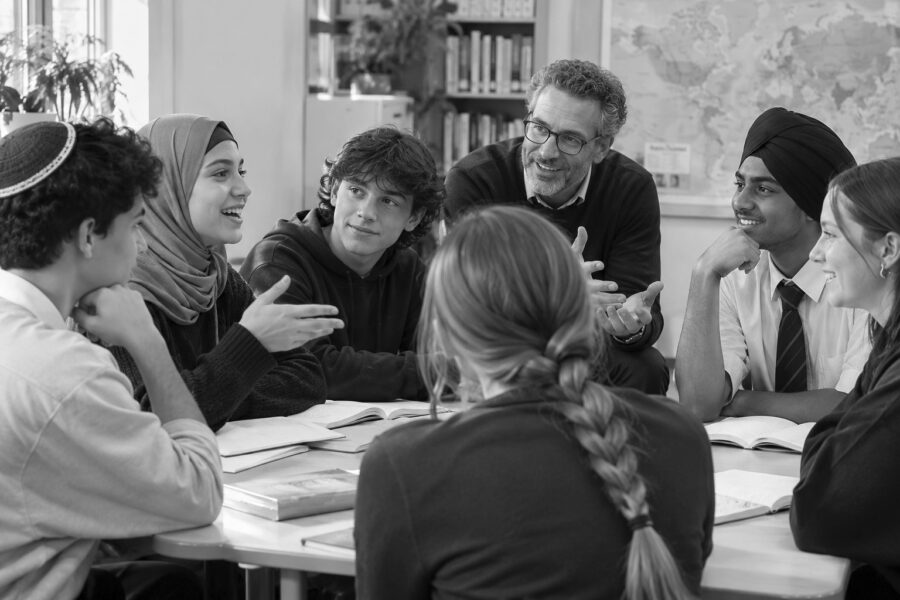
Walk into a Victorian government school and ask how religion is handled in the classroom, and you will often get a blanket response: we don’t go there, we’re secular. In a time of geopolitical conflict and rising polarisation at home, it is an understandable response, even a convenient one. It also rests on a misunderstanding. Secular schooling means schools do not promote or practise any religion; it has never meant that students cannot learn about the beliefs shaping their fellow classmates’ lives. In the gap between those two meanings, a generation is growing up around difference it has never been helped to understand or navigate.
In August this year, I was invited to give evidence addressing that gap before the Royal Commission on Antisemitism and Social Cohesion. I shared with the Commission that many teachers lack the confidence to talk about religion in the classroom. Students, in contrast, want to talk about belief, yet most have never been given a serious opportunity to do so.
This raises an awkward question for Christians. How do we engage schools, and public institutions generally, in an Australia where the topic of religion is avoided?
At the last census, fewer than half of Australians identified as Christian and nearly forty per cent ticked no religion. Among teenagers the picture is more complicated than simple unbelief. The Australia’s Generation Z study surveyed 1,200 teens aged 13 to 18: about half claimed no religion, yet only 23 per cent were firmly secular in outlook, and most were open to religious diversity in others. What they lacked, the researchers found, was religious literacy. Young people are navigating real diversity without the knowledge to do it well, and students who are taught about religions and worldviews in a structured way hold markedly more positive views of religious minorities than those who are not. Teachers feel the gap too: many report limited confidence, resources and preparation for the questions about religion already arriving in their classrooms.
This is not only a Christian concern. When Australians misread and misunderstand each other’s worldviews, the social fabric frays and the trust that undergirds our society erodes away. We all have a stake in mending it, religious or not.
However, when it comes to education, particularly religious education, there is a hesitation many Christian will feel. We gladly support single-faith religious instruction, the opt-in classes faith communities offer in government schools (SRI in Victoria, SRE in New South Wales and other states). But education about many faiths makes us uneasy. What if our students find another tradition attractive? What if the gospel becomes one option on a shelf? A gospel that must be protected from comparison is a gospel we have quietly lost confidence in. Our children will encounter other worldviews either way, which many already have. The real question is whether they meet that difference with fear or with confidence.
Lesslie Newbigin understood this fear. He spent almost forty years as a missionary in India before returning to England, where he found a mission field harder than the one he had left. Western culture, he argued, treats faith as a private preference rather than a public claim, and the church had settled into two moods: timidity, a faith too polite to speak in public, and anxiety, a busyness that ‘only thinly masks a lack of confidence in the sufficiency of God’. He commended a third posture: confidence. Christians should welcome a plural society, he wrote, because it offers ‘richer opportunities for testing the sufficiency of our faith’. Confident people do not need to control the room. They can listen carefully, speak plainly and trust God with the outcome.
England is further down this road than we are. Its Religious Education has been moving toward a ‘religion and worldviews’ approach for the past decade, built on the recognition that everyone sees the world from somewhere, religious or not. So, Nobody stands nowhere.
The strongest evidence so far is a study published this year in the British Journal of Religious Education, which followed 826 school leavers into university. Students who had learnt at school that worldviews are internally diverse, and shaped by personal decisions as well as tradition, were the best equipped to engage difference well as undergraduates. A 2026 survey of people of faith by the Institute for the Impact of Faith in Life points to a similar outcome: 56 per cent said RE had a positive impact on their schooling against five per cent negative, and it was religious minorities who reported benefiting most.
Australia has barely begun this conversation. Through four years of multifaith facilitation and consultation led by Faith Values, the Religions and Worldviews Education (RWE) pilot is trying to address that gap. Faith Values, a Christian organisation, has convened Christian, Jewish, Muslim, Hindu, Sikh, Buddhist and multicultural partners through the Multi-Faith Education Collaboration (auspiced by the Faith Communities Council of Victoria). Out of that patient work came an eight-lesson unit for Years 7 and 8, now being piloted across government, Catholic and independent schools in Victoria, with a wider government school rollout to follow and the University of Melbourne evaluating it independently. The most consistent feedback so far is: students of faith backgrounds feel seen and teachers report greater confidence in teaching about religions and worldviews.
This is also where RWE sits alongside SRI rather than replacing it. SRI nurtures students in the faith tradition their families have chosen, and that work matters. RWE answers a question SRI was never designed to answer: how every student, of any religious background or none, learns to understand the beliefs of the people around them. Taught by the school’s own teachers within the curriculum, RWE belongs to the school, engages students who would never opt in to anything, and rebuilds the confidence that the misreading of ‘secular’ had taken from teachers.
RWE is education about religions and worldviews, not instruction in any of them. Teachers facilitate rather than advocate. Students may share their own worldviews as they learn about each other’s, but no one is asked to represent a faith or disclose their own.
What Newbigin grounds in the gospel, the legal scholar John Inazu describes as a civic practice. He calls it confident pluralism: holding our deepest convictions firmly while building a shared life with people who reject them. Across Confident Pluralism, Uncommon Ground (written with Timothy Keller) and Learning to Disagree, he keeps returning to three modest virtues: tolerance, humility and patience. An RWE classroom enables students to live out these virtues. Students are invited to practise sentence stems for disagreeing and agreeing well; none of this is caught by accident, and like reading, it has to be taught. It all leads to the unit’s driving question: how do we get along living in a diverse society? It’s a question Australia is currently grappling with.
Newbigin asked one more question: how can the gospel be credible in a society whose assumptions run against it? The only thing that makes the Christian message believable, he wrote, is ‘a congregation of men and women who believe it and live by it’. How we show up as Christians matters. It is visible in how we partner with people of other faiths and of none, and in serving schools that will never privilege us. Jeremiah told the exiles to seek the peace and prosperity of Babylon, a city they did not control, because their welfare was bound up with its own. I am once again reminded that the church did its best work from the margins long before it held any power or status.
So how do we as Christians resist the culture wars, the silent retreat, and the fear that sits beneath them both? We need to pray for our schools, for students navigating identity and meaning in a complex age, and for the teachers who shape how they see the world. Shalom, the Bible’s word for peace, has to be pursued, and education that connects across differences is one practical way to pursue it.
Herbert Um is the CEO of Faith Values (faithvalues.org.au), a Melbourne-based Christian not-for-profit organisation committed to strengthening quality Religions and Worldviews Education in Australian schools. He is the Project Director of Religions and Worldviews Education (reworldviews.org.au) and is a member of the Australian Curriculum, Assessment and Reporting Authority’s Australian Values Advisory Group. He is currently undertaking a Master of Theological Studies at Ridley College.
References
- Lesslie Newbigin, The Gospel in a Pluralist Society (SPCK, 1989)
- John Inazu, Confident Pluralism (University of Chicago Press, 2016); with Timothy Keller, Uncommon Ground (Thomas Nelson, 2020); Learning to Disagree (Zondervan, 2024)
- A. Singleton, A. Halafoff, G. Bouma and M. L. Rasmussen, Australia’s Generation Z study; Halafoff et al., ‘Religious literacy of Australia’s Gen Z teens’, Journal of Beliefs & Values 41(2), 2019
- A. Halafoff, K. Lam and G. Bouma, ‘Worldviews education: cosmopolitan peacebuilding and preventing violent extremism’, Journal of Beliefs & Values 40(3), 2019
- Rania Mohiuddin-Agir, Faith, Fluency and the Future of Religious Education in Britain (Institute for the Impact of Faith in Life, September 2026)
- Lucy Peacock, Mathew Guest and Kristin Aune, ‘Religious Education and “interfaith readiness”’, British Journal of Religious Education, July 2026
- Theos, ‘Nobody Stands Nowhere’ (animation, 2021)