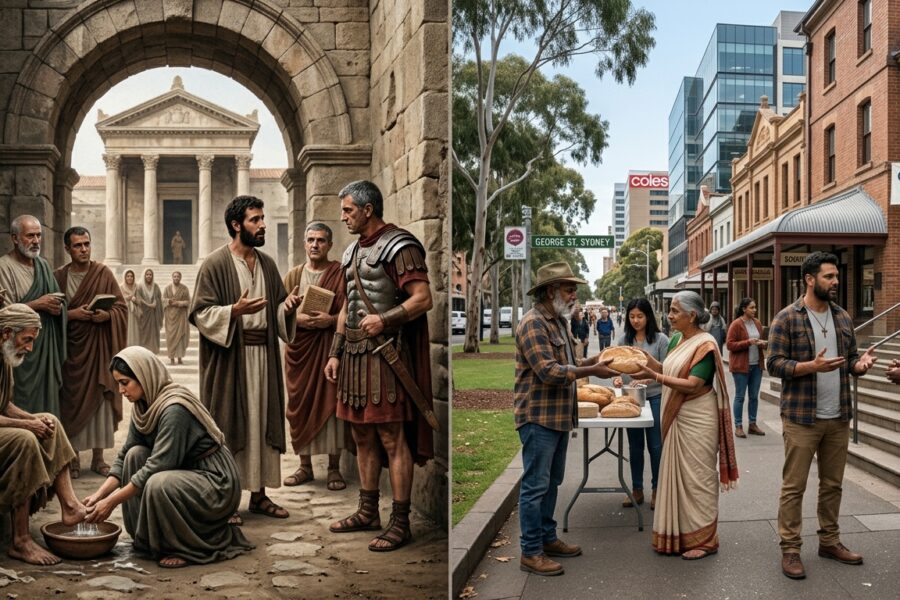
In this brief reflection, I seek to emphasize that being citizens and being Christians have very much to do with each other. In developing this, I seek to overcome various perspectives that undermine the notion of their dynamic relationship. And positively, I seek to argue that Christians live with the joy and challenge of a double mandate: undergirding and building up the faith-community and contributing to the common good in society through service and prophetic witness.
Since the history of the Christian church is a long one and is formed and shaped in many different historical epochs and cultural settings, we should not be surprised that the church is not a uniform entity. It is marked by basic commonalities yet significant diversity. The existence of more than 30,000 different denominations globally (currently) is but one reflection of this diversity (although much of this diversity could readily be overcome if Christians were more cooperative rather than competitive). Therefore, it should not surprise us that there are different perspectives on the topic of this reflection.
There are Christians who think that their only task is in relation to their faith-life, family and the church, and their only ‘duty’ to society is evangelisation through faithful witness in the church’s corporate life.
At the extreme end of this perspective are Christians who think that they need to let the world go its own destructive way so that Christ will return all the sooner to clean up the mess and usher in a new kingdom.
In these two postures, being a good Christian is paramount. Being a good citizen remains obscure. At best, it is under-emphasized. The problem is that this generates a world-denying form of Christianity.
If the above is placed at one end of the continuum, the other end is where church and societal, and Christian and secular issues, become merged. Here, being a good citizen almost equates with being a good Christian. And being a good Christian has to do with seeking to do good only for the world. This liberal theological perspective hollows out Christian distinctives. It overplays the human reality and underplays transcendent perspectives yielding a world-conforming form of Christianity.
Somewhere in the middle is a much more representative biblical/theological perspective. Its fundamental dynamic is dialectical. Here there is the challenging interplay between church and world and world and church. And this shapes our understanding of what being a good Christian and a good citizen may look like.
Let me attempt to sketch this out in a variety of ways. I am weaving a tapestry rather than providing a simple definition. The Christian is wholly “unworldly” and wholly for the world. The Christian is sustained by and affirms the world but rejects its worldliness. The Christian while “heavenly minded” – holding transcendental values – seeks to deeply penetrate the world. The Christian sees the world as a blessing, resource, and responsibility, but resists its idolatrous claims. Thus, the Christian is both for the world and against it.
The ideas here are: ‘in and not of the world’; wholly for the world but not on the world’s idolatrous terms; for the ways of the kingdom of God and so for the world; seeing the world as gift of the Creator God and not as a self-contained entity; living in responsibility for the world through the inspiration of the biblical narratives and the leading of the Spirit.
The implications that flow from this, are myriad. First of all, Christians are to live with gratitude and joy in the world of nature and the human society. They see both as God’s gift for human sustenance and ordering. And as gift, they acknowledge the call to live productively and responsibly in the world as carers and transformational agents.
Secondly, Christians see themselves as an insertion in the world for the world’s betterment. They see themselves in terms of the metaphors of salt, leaven, and light. These terms suggest preservation, transformation, and enlightenment. And this is outworked in witness, service, and redemptive suffering. None of this language—note, none—suggests domination, manipulation, and Christian empire building.
Thirdly, Christians live with deep appreciation and gratitude towards their neighbours and society as whole. So much is good and so much is given. And, therefore, Christians live with a hermeneutic of affirmation and so seek to affirm all that is good in the world. In this they out-work their societal-cultural calling as good citizens. However, they are also tasked with a hermeneutic of suspicion. They are to question, resist, and seek to overcome what is unjust and dysfunctional in society. Here they have a prophetic duty. And they are, consequently, seen as irritants and troublemakers.
But all of this needs a strong dose of realism and more than only the aura of repentance. Christian churches, institutions, and organisations are also flawed, and fail to live the inspiration and power of the gospel. And while the Christian church in its long journey in history has done much good in the world, it has also done evil: the Crusades, the Inquisition, and the collusion with state power and colonialism. And the church has often been acquiescent rather than prophetic.
While so much more could be said about all of this, let me make some broad suggestions. And hopefully you may take this up and push the boundaries of this brief reflection. As citizens, Christians receive much and should live with deep gratitude and responsibility in family and other relationships, in the workplace, in voluntary activity, and in expressing political concerns. They should take their citizenship seriously and seek to contribute to the common good. As Christians, Christians are ever called to more fully live in the way of Christ, to be prayerful regarding all that is happening in their lives, the church, and the wider society, and seek to be blessing to others and do good in society. And as Christians they are called to be those who long for a deeper relationship with God, to seek God’s kingdom, and anticipate God’s final future.
The Christian is both a citizen and a participant in the kingdom of God. The Christian receives much from his/her fellow citizens and from society as a whole, and the Christian receives much from his or her relationship with God, the faith-community, and spiritual practices. Thus, doubly blessed, the Christian is doubly responsible for society and the purposes of God.
In all of this, the Christian lives with gratitude and in humility. The Christian is not ‘better’ than others, but different. And this difference is expressed in service, never in domination, and never in Christian empire building.
In all of this I am not suggesting an easy and smooth path. The journey of citizen and follower of Christ will have its ambiguities and tensions. But one can and should live both to the glory of the Creator and Redeemer God.