New Book Title from Dr. Mersina Papantoniou
The Multicultural Challenge to Sydney Anglican Identity:
Its Achilles’ Heel—an Interdisciplinary Approach, May 2026
Book review by Duncan Reid below….
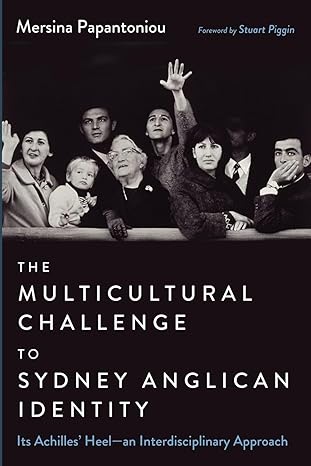
In light of the ongoing contested spaces regarding Australia’s unique social policies of Australian Multiculturalism, the following book is a most timely analysis in how such policies were originally constructed and why? Despite being used as a “political football” in peoples’ everyday lives. Australia is considered today and internationally, to be ‘one of the most successful multicultural societies’ in the world.
This stand-alone work outlines a uniquely longitudinal view to the construction of such policies and successive attempts at their dismantling. The book analyses the consequences of the ‘white Australia policy’ especially in regards to diasporic Greek migration struggles in Australia, recognized and noted.
Corresponding themes in the book include, the use of the colonial British ‘social imaginary’, the use of political philosopher Castoriadis’s concept of the ‘political imaginary’ and of course the ‘whitelash’ in response to the still smouldering: ‘White Australia policy’. Yes, even noting ‘colour’ descriptions, as historically examined through Australia’s evolving social policies. These struggles are juxtaposed with the second major axiomatic theme to the book running in parallel: the creation of a little-known department of cross-cultural ministries in the Anglican Diocese of Sydney (DCCM), 1987-2000. The department straddles the theological/praxis divide of the diocese concerning ministry with migrants and refugees. The department is placed in what was one of the largest welfare organizations in Australia, the Sydney Anglican Home Mission Society, later re-branded Anglicare NSW.
The contrasted analysis exposes the Achilles’ heel with regards to the social welfare debates of the period, alongside examining the implementation of Australia’s social policy of multiculturalism. This ultimately becomes, one of the most turbulent and polarizing episodes in its denominational history.
This book is intentionally written using a social sciences interdisciplinary approach, exploring social policy within a contemporary First World setting. However, with a deliberate view from the grass-roots—through the eyes of the laywoman of Greek non-English speaking background who founded the Sydney, Department of Cross-Cultural Ministries (the author). Yet, the theological/praxis and secular social policy debates continue to this day.
This book will become the ‘go-to reference’ regarding an analysis of struggle, in both secular and sacred approaches – not only for diasporic communities, but also for students of social policy and political theory, regarding the ongoing construction of nationhood, with societies built on Immigration.
Dr. Mersina Papantoniou (Soulos) has taught in the Faculty of Arts and Social Sciences, University of NSW, and at the Oxford Centre for Mission Studies, (OCMS) Oxford, U.K. Her research interests include the nexus between postmodernism and the thought and practice of religion, in its various iterations within contemporary diasporic cultures. Her newly published book titled:
The Multicultural Challenge to Sydney Anglican Identity: Its Achilles’ heel- an interdisciplinary approach. Is an extraordinary achievement as it encompasses an examination of Australia’s unique social policy through the secular social science disciplines and in parallel an examination of a religious denominations response. Her other published works this January 2026 include:
Papantoniou (Soulos), Mersina. “The Un-Making of a White Jesus”. Chap. 5 In Theological Conversation on Country: An Aspiration, edited by John Bottomley and Duncan Reid. Series: A Forum for Theology in the World, 45-60. Adelaide, S.A.: ATF Press, 2026, January.
Please take the opportunity to order for your Library. For book orders, (paperback, hardcover and digital form) please see: https://wipfandstock.com/9798385240913/the-multicultural-challenge-to-sydney-anglican-identity/
Orders can also be made through your local bookstore and online.
Book Review by Duncan Reid
Mersina Papantoniou, The Multicultural Challenge to Sydney Anglican Identity: Its Achilles’ Heel—an Interdisciplinary Approach (Eugene, Oregon: Pickwick, 2026), 366 pp. ISBN: 979-8-3852-4091-3. RRP AU$48.00.
This book, based on the author’s doctoral thesis and her own experience as founding co-ordinator of the Department of Cross-Cultural Ministries (DCCM) of the Anglican Diocese of Sydney from 1987 to 2000, is full of surprises. At some point in my reading I found myself jotting exclamation marks in the margins every so often: did someone actually say this, or do that?
But there it is, very professionally written in third-person autoethnographic style that seeks, and generally succeeds in this, to distance the author from the subject matter, and all painstakingly documented in the copious, carefully researched footnotes. The list of abbreviations and exhaustive bibliography give weight to this, though an index of names and themes might have been a helpful addition. The interdisciplinary approach referenced in the book’s subtitle is the interconnection between anthropology, sociology, cross-cultural psychology and theology: the author is a social scientist and historian by background, and brings methodologies from these disciplines to bear on the different paradigms of ministry at work in the official theology of Sydney Anglicanism.
The ‘Achilles’ Heel’ refers to the increasingly embattled ‘white Australia’ mentality of a diocese in a time and place of rapid demographic change, expressed in the Labor federal government’s policy of multiculturalism. By contrast, for mainstream Sydney Anglicanism, its ‘purist’ brand as the author calls it, the multiculturalism expressed in section 5 of the 1974 Lausanne Covenant was ‘a danger to be avoided’ (p. 37). This book is the story of the brief flowering of multiculturalism within Sydney Anglicanism during the 1990s, in the face of unrelenting opposition from advocates of the Homogeneous Unit Principle (HUP), an essential part of the Church Growth Model, with its vision of monolingual, monocultural, middle-class megachurches. It is a story told with passion and verve.
‘How did it come to this?’ (p. xxxv) is the question the author seeks to answer. Here, and at various points in reading the book I was reminded of the 2006 article ‘The Properties of Concrete’ by Stuart Piggin, who also supplies the foreword to this book. In that article Piggin offers a list of possible dates, starting with 1788, for when Sydney Anglicanism began to turn to concrete. The biggest surprise in Papantoniou’s book however—to me as a moderately high church Anglican, whose personal formation lies in the social action model of the Student Christian Movement and the World Council of Churches—is that Sydney Anglicanism is not simply monocultural. Admittedly I should have known this already—apologies to my own Sydney relatives with their multi-generational involvement in the work of the Church Missionary Society (CMS). Sydney also has its long-standing and very resilient ‘radical minority tradition.’ Papantoniou acknowledges this and documents the historic Anglican ministries to the Aboriginal and Chinese minorities of Sydney. The book is by no means an anti-Sydney, or anti-evangelical, diatribe. Papantoniou emphasizes more than once that the Home Mission Society, the umbrella organisation for her innovative cross-cultural work, was founded in the same year as Moore College, the bastion of theological conservatism. With citations of names and Synod resolutions all the way through the period under discussion, the author tells the story of the DCCM, making connections to changes in government social policy and legislation, some of them driven behind the scenes by significant church leaders: Jim Houston and Brian Howe, among others. The overall burden of the story, however, is one of a golden opportunity lost, an opportunity built on tireless work and unreserved commitment to the gospel of salvation. A major theme running through the book is the largely unacknowledged ‘invisible work’ of women in running church agencies. Among the most appalling episodes in the unravelling of this endeavour is the author’s account of her own dismissal. This was the result of the 1997-2000 restructure of funding for such diocesan agencies (pp. 276-280).
This is a book that carries its scholarship lightly: there are references to theorists like Gramsci and Levinas, and uses of technical terms like intersectionality and the distinction between intercultural and cross-cultural, but these are offered, with careful explanations, to help the reader, not simply to mystify or impress. I strongly recommend Mersina Papantoniou’s book to anyone interested in the Anglican church’s place and future in contemporary multicultural Australia.
Duncan Reid
Adjunct, Trinity College Theological School Melbourne
Secretary, Religion and Social Policy Network
Honorary Research Fellow, University of Divinity